| Welcome, Guest |
You have to register before you can post on our site.
|
| Latest Threads |
Protocol for BESS measure...
Forum: Edge Sharpness Testing
Last Post: grepper
05-02-2026, 08:31 AM
» Replies: 8
» Views: 7,176
|
How to prevent the edge o...
Forum: All About Edges
Last Post: WI_Hedgehog
04-30-2026, 01:12 PM
» Replies: 6
» Views: 16,217
|
Blade Taper Angle? - Supe...
Forum: All About Edges
Last Post: WI_Hedgehog
04-30-2026, 01:01 PM
» Replies: 9
» Views: 26,284
|
Knife dulls overnight aft...
Forum: All About Edges
Last Post: WI_Hedgehog
04-30-2026, 09:01 AM
» Replies: 27
» Views: 85,876
|
The DILAGON: a DIY laser ...
Forum: All About Edges
Last Post: WI_Hedgehog
04-30-2026, 07:57 AM
» Replies: 27
» Views: 110,163
|
Used Rapid Edge Extend-A-...
Forum: Relevant General Discussion
Last Post: WI_Hedgehog
04-30-2026, 06:49 AM
» Replies: 3
» Views: 7,087
|
Saved old tool (Fun with ...
Forum: Relevant General Discussion
Last Post: WI_Hedgehog
04-30-2026, 06:43 AM
» Replies: 1
» Views: 2,874
|
Mike Brubacher has passed
Forum: Relevant General Discussion
Last Post: WI_Hedgehog
04-30-2026, 06:15 AM
» Replies: 2
» Views: 2,223
|
The definition of 'blunt'
Forum: Edge Sharpness Testing
Last Post: subwoofer
02-04-2024, 12:16 PM
» Replies: 2
» Views: 4,569
|
Avg BESS score for cheap ...
Forum: Edge Sharpness Testing
Last Post: grepper
04-24-2023, 12:04 AM
» Replies: 1
» Views: 5,151
|
|
|
| Flattening Veneve Diamond Stones |
|
Posted by: rwfishman - 12-31-2018, 02:52 PM - Forum: Relevant General Discussion
- Replies (1)
|
 |
Happy New Year All!
I've been watching some YouTube videos on flattening Venev diamond and other stones and one method includes using a glass plate with water and silicon carbide grits. What type of glass is the best to use, tempered, not tempered, or does it matter, and how thick should it be? I've been able to find almost everything else on the subject except this. One person said "plate glass" but later referred to it as "tempered" but those 2 types of glass are not the same. I'd appreciate any input and suggestions.
Thanks again!
Randy
|

|
|
| looking ahead to the New Year |
|
Posted by: Ken S - 12-31-2018, 05:25 AM - Forum: Relevant General Discussion
- Replies (1)
|
 |
The bessexers have been pushing back the knowledge frontier in sharpening for several years. This innovation has been remarkable; I have no doubt it will continue in the new year and beyond. A special thank you to Mike for making this exchange possible.
This exchange is like the space program. We are reaching beyond the moon and the 50 BESS "sound barrier". At the same time, this rising tide of knowledge will float all boats; the average sharpener and cook will see sharper knives, knives which also retain that sharp edge longer.
Keep up the good work, fellow bessexers!
Happy and Productive New Year!
Ken
|
|
|
|
| Inconsistent Results |
|
Posted by: Mike Brubacher - 11-19-2018, 04:46 PM - Forum: Edge Sharpness Testing
- No Replies
|
 |
Recently three posts, in a new thread, were made to the BESS Exchange describing a wide range of problems experienced by three of our customers. These issues included old and new style ATFs whose results didn't match, PT50As that did not match the results of PT50Bs, DE razor blades that yielded abnormally low readings etc.. The original thread was taken down due to inappropriate posts made by some of our Exchange members. Those three original posts are copied in their entirety at the bottom of this post. The posts made by other Exchange members as follow up to the three original posts are not included.
We promised to look into these claims for these three customers and have done so. We have been in communication with one of the posters and cleared a couple of reported problems (i.e. PT50A/B discrepancies) up in so doing. We spent part of last week and this weekend looking into the balance. We believe, with a great deal of confidence, that we now understand the problem.
The root problem for all these reports lies with the new ATF-10G. The ATF-10G utilizes a plastic clamping nut on a steel stud to provide compressive force in locking the test media down. Only a very moderate amount of rotational force is required to accomplish this. A plastic nut is utilized in this application so that the finish of the test media seat is preserved. Only by tightening this nut well beyond the requirement were we able to begin duplicating some of the more extreme findings of our three customers. The problem has it's roots in the plastic threads of the clamping nut. These threads will "give" allowing the user to keep tightening and rotating the nut thereby applying more and more tension to the test media. In fact, taken to extreme, the test media can be permanently damaged in this effort.
We do acknowledge that the perfect "window" for tensioning is not as large as we would like. We identified two very simple fixes to greatly enlarge this window; (1) We have inserted a simple flat washer into the scheme that acts like a bearing between test media and nut. In this system the plastic nut spins on the washer as opposed to the test media.(2) A nut with metal threads prevents the over rotation of the nut. We are sourcing plastic nuts with metal thread inserts.
All new instruments are being shipped with new instructions and washers in place on the ATF-10G. Use of the washers is optional for users. Once we receive our new plastic nuts with metal thread inserts we will test to see if it is an even simpler fix or, possibly, used in addition to the new washer. These are the only three complaints we have received to date regarding tensioning difficulties but one never knows, there could be some who are suffering in silence. If so, let us know via email and we will send a washer (M4 flat washer). In the future, we ask that customer service questions of this nature be submitted directly to us via email. If something of universal and general interest arises out of the solution, we will post it to the Exchange.
Here are the new instructions that accompany all new units that utilize the ATF-10G.
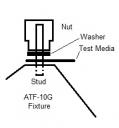
ATF-10G supplemental instructions. Your ATF-10G includes a washer that acts as a bearing between test media and the beveled seating surface of your ATF-10G. This arrangement prevents accidental over tensioning and potential damage to the test media during the clamping process. Over tensioning can occur when the plastic nut is intentionally tightened well beyond the point necessary to secure the test media. Over-tensioning results in artificially low (10-20 pt.) BESS scores.To re-run test media; loosen the plastic feed screw a full turn and then pull/feed-out the necessary amount (approximately 2.5 inches, 65mm) of test media. Snug the plastic feed screw back down. Crack the clamping nut open allowing enough room for the test media to pass between washer and fixture bevel. With one hand, grasp end of test media and "slide' test media under washer until test media drops into slot. Pull all the slack out of the test media gently (no remaining hump or dip across the measurement gap of the ATF) and then tighten clamping nut moderately. Now you're ready to take your next edge measurement
Here are the original three posts in their entirety:
Hi all.
So I'm in the unique position to have both a PT50B and a PT50A.
Straight away I noticed inconsistent results between the two units.
Long to short I'm seeing around a 30% increase in the scores on the ATF10G (with the nut) I've chewed up about a mile of test line this weekend trying to get consistent results.
Seems the newer ATF10G line holder is very variable depending on line tension. Another note is that the older ATF line holder has a "bolt" style line lock. The ATF10G is a "nut" arrangement. The bolt style on the ATF definitely adds an element of line tension as the rotation tightening pulls on the cord. This seems quite consistent with the tension on the side of the ATF.
So I tried the bolt arrangement on in the ATF10G clamp and got very varied results (like as low as 10 BESS up to 46 BESS on a newly sharpened kitchen knife). Consistent scores of around 30 with the ATF holder. (knife scored 77 on a clip)
Some of you will know I've been using my PT50B in edge testing on YouTube. The change in results will render my testing over. I can't make the call on under 160 BESS being "shaving sharp" with the ATF10G.
I had one knife that scored a consistent 100 bess in the ATF, edge was easily popping arm hairs off. With the ATF10G I was scoring over 160 BESS. No way it was over that golden number. (clips scored 155 & 156).
Is anyone else seeing results this varied or am I unique having two different units.
I was really hopefully the BESS measurement was a consistent thing but it seems not.
NJMS and I , as well as a couple other sharpness nerds have been discussing our inconsistencies extensively, trying to figure out how all our results could vary so much. The tiniest fraction of difference was between spools, the big difference is certainly the fixtures. I spent months pulling my hair out (literally) trying to figure out why I couldn't match their scores, whilst being able to achieve the same sharpness feats as them. I would have an edge that treetops the hair off my arms and legs, would sever my hair on contact, (in the hanging hair test it would be a HHT4 or HHT5) yet would score 70-80 on my tester with the 45 degree fixture. I have no doubt in my mind that if I added tension to replicate what happens when tightening the old fixture, it would have been scoring sub 40.
We came to the conclusion there was definitely something wrong when I demonstrated to the group, a 200+ bess edge whittling hair and popping the hair off my arms. We found minor discrepancies on older vs newer spools, thats no big deal, turns out we never checked the fixtures until today.
Using my razor, I can score 5 Bess by adding more tension to the filament, If I have it so its just a bit tighter than slack, that number raised to 25, having very slight slack raises it to 55.
The only way I can see making the fixtures absolutely dead accurate is to have a screw with a hole in it that you feed the string through loosely, and a knov that only tightens to a certain amount of torque before spinning and not tightening the string anymore. Problem is that would use a lot of filament.
New member here, and fairly new sharpener. I'm one of the sharpness nerds mentioned by rs-Travis. While I don't yet have the skill or experience of rs-Travis or NJMS, I have had similar results. I've had hair-whittling edges in the 170s and above (227 on the clips and whittles hair). So I ran a series of tests on my PT50A and found two trends.
1) One test was for various degrees of media tension on the ATF10, using a Dorco DE blade.
I found that looser media produced a higher number. Using the subjectively-felt tension in the clips as a baseline, I found that higher tension on the ATF10 yields lower numbers. Stretching it very tightly yielded a 14, whereas stringing it more loosely than the clips's tension gave me a 64. The clip itself yielded a 56.
2) Another test was comparing the ATF10 to the ATF10G on a series of 10 knives, with the same canister of media, at fairly constant tight tension.
I found that the ATF10 yields consistently lower numbers than the ATF10G. For example, a Spyderco PM2 scored 42 (ATF10) and 73 (ATF10G). A Victorinox scored 144 (ATF10) and 189 (ATF10G). I wonder if this is because the thumb-screw on the ATF10 adds tension to the media as it tightens down to secure the media?
|
|
|
|
| Can beauty scissors be sharpened with a belt grinder? |
|
Posted by: SHARPCO - 11-18-2018, 03:12 PM - Forum: All About Edges
- Replies (10)
|
 |
As you know beauty scissors has convex edge. So to sharpen it, we need WOLFF Hira-To or TAS(& convexing clamp).
But belt grinder(e.g. Viel, Kally) can sharpen convex edge knives.
How do you think about it? Is there any problem with sharpening beauty scissors with belt grinder?
|
|
|
|
|



![[Image: uNVcLCn.jpg]](https://i.imgur.com/uNVcLCn.jpg)
![[Image: fbhoPML.jpg]](https://i.imgur.com/fbhoPML.jpg)
![[Image: KeIabef.jpg]](https://i.imgur.com/KeIabef.jpg)
![[Image: SPy83AL.jpg]](https://i.imgur.com/SPy83AL.jpg)
![[Image: hg2K5Z2.jpg]](https://i.imgur.com/hg2K5Z2.jpg)
![[Image: YzMJ9G5.jpg]](https://i.imgur.com/YzMJ9G5.jpg)
![[Image: 67R1p71.jpg]](https://i.imgur.com/67R1p71.jpg)
![[Image: 9g9Nr5Q.jpg]](https://i.imgur.com/9g9Nr5Q.jpg)
![[Image: wImhzVD.jpg]](https://i.imgur.com/wImhzVD.jpg)
![[Image: BQlgJh0.jpg]](https://i.imgur.com/BQlgJh0.jpg)

