Posts: 500
Threads: 38
Joined: Mar 2017
Thank you very much Scott. We're learning although slowly. So I think that we read earlier in this thread that the potential HRC on this powder material (SV30) is in the 60-62 range. Does that mean approximately the same for sintered? Here's where we're going next with this question assuming that the answer is in the affirmative. John Lucas mentioned ( in one of his wood working posts here or emails) that he had done some work with sintered hand plane blades. He commented that they had arrived quite sharp, were very durable edges, but were extremely difficult to re-sharpen. Does this seem to follow? If so, why would they be so difficult to sharpen?
Posts: 101
Threads: 2
Joined: Dec 2017
The hardness range would be similar, however I don't think you'd see very many cutting tools with just sintered blades. The process, at least for cutting tools, starts with sintering of metal powder, and is followed by hot rolling. The hot rolling is necessary to get shapes convenient to make cutting tools (sheets instead of 5" thick billets), and to remove any small bit of remaining porosity that might be left over. The goal is to sinter to 100% density (no porosity remaining), but hot rolling ensures it even more. The spaces between the particles are already quite small, but with edges on the order of 1 micron, even tiny pores could have detrimental effects.
The difficulty in sharpening comes from the high volume of very hard carbides generally found in CPM/powder type steels. The carbides are often harder than the common abrasives used. Vanadium carbide is harder than the aluminum oxide used in common sharpening stones, and about the same hardness or a bit harder than the Silicon Carbide used in common stones and wet/dry sand paper. These other stones can be used to sharpen, but require more care, knowledge, and skill. Diamond can be used, but a fair amount of care is still needed, and even with diamond, it takes longer than normal. I have a blade in S110V that frustrates me to no end, as I'm not able to get it as sharp as my other blades, even with diamond stones down to 1200 grit (DMT Green Extra Fine). S110V has a fair portion of very hard vanadium carbides.
Posts: 500
Threads: 38
Joined: Mar 2017
Well we're smarter this afternoon than we were this morning me2 so that makes it a good day. Thank you for taking the time to explain this. It is quite interesting and more things make sense to us now. Given the time we're going to learn more about the various ways and means that powders are formed into cutting edges. Its just intriguing stuff.
Posts: 101
Threads: 2
Joined: Dec 2017
I appreciate the sentiment. Now I have to go try to sharpen that S110V blade again. 
Posts: 592
Threads: 26
Joined: Mar 2017
Reputation:
0
(02-22-2018, 11:49 AM)EOU Wrote: Thank you very much Scott. We're learning although slowly. So I think that we read earlier in this thread that the potential HRC on this powder material (SV30) is in the 60-62 range. Does that mean approximately the same for sintered? Here's where we're going next with this question assuming that the answer is in the affirmative. John Lucas mentioned ( in one of his wood working posts here or emails) that he had done some work with sintered hand plane blades. He commented that they had arrived quite sharp, were very durable edges, but were extremely difficult to re-sharpen. Does this seem to follow? If so, why would they be so difficult to sharpen? Yes, thank you for the clarifications you point out, Mr. Scott. I am so used to the new version of blade steel type M4, powder CPM M4, I tend to overlook the other ones. Besides Hitachi's awesome "colored" high carbon blade steels, they make my favorite stainless powder steel, ZDP 189.
Your suggestion of CPM steel orifices for injection molds does sound most likely as well.
I assume that one could use the term "sintered" to describe the formation of an ingot of powder steel, or the formation of a molded part. It seems like totally different ways of ending up with about the same resultant steel to me. With molded, sintered parts, you can eliminate what would be a lot of arduous, if not impossible, machining.
Whether you're talking about molded powder steel parts or rolled powder steel blade material, the hardness and other properties are going to totally depend on the heat treatment of either one.
I too would assume that John Lucas's plane blades are rolled, and not "just sintered", as Mr. Me2 described. In other words, as far as sintered steel blades go, they are not molded, but rolled and ground, like all powder blades, because it's very straightforward stock removal.
I have a Veritas PM 11V plane blade and a PM 11V wood chisel. I know of other woodworking blades in CPM 3V, and it wouldn't surprise me if they are identical, with Veritas just giving theirs a proprietary name. I don't know of any other steel designated PM 11V, and I rather doubt Veritas would be able to convince Crucible or whoever to make a different powder steel just for them. 3V would be a good candidate for woodworking blades, as it is a very tough powder steel.
Manufacturers almost certainly use diamond or CBN abrasives to turn out acceptably sharp powder steel blades from the factory. John Lucas may be using his standard regimen for good carbon steel blades, which simply won't be effective on high vanadium powder steel.
Posts: 592
Threads: 26
Joined: Mar 2017
Reputation:
0
02-25-2018, 09:17 PM
(This post was last modified: 02-26-2018, 12:29 PM by Mark Reich.)
(02-22-2018, 05:02 PM)me2 Wrote: I appreciate the sentiment. Now I have to go try to sharpen that S110V blade again.
That's the problem with all the "high wear" super steels. IMHO sharpen-ability is more important than what little extra edge holding there's supposed to be.
If you can't get S110V, or S90V (very little difference) sharp in the first place, what good is it? You're stuck with a mediocre edge for a long time.
I've totally given up comparing all the "high performance" stainless steels to CPM M4. I don't have much problem keeping carbon steel from rusting, although will I admit I don't like the way M4 pits.
M4 is easier to sharpen than M390, or any of it's variants. It's at least a couple points harder than S110V, which is probably why it holds a sharp edge obviously longer IMHO.
52100 only surface rusts, and I couldn't care less about it. A little oil and green scotch brite (no abrasive) has a blade looking fresh as a daisy in seconds. Sharpening to edge holding ratio is probably unbelievable. I literally spend less than 3 seconds per deer on average, or a minute per month on my EDC, and that's Non Powered. Just an Atoma.
(I don't sharpen "per deer". The edge is usable for dressing about 20 deer and it takes 60 seconds to sharpen)
Posts: 500
Threads: 38
Joined: Mar 2017
"That's the problem with all the "high wear" super steels. IMHO sharpen-ability is more important than what little extra edge holding there's supposed to be.
If you can't get S110V, or S90V (very little difference) sharp in the first place, what good is it? You're stuck with a mediocre edge for a long time."
That makes a lot of sense to us Mark. We tend to gear our thinking around here to the average knife user. The average knife user thinks of his knife strictly as a tool. Anything that makes maintenance of that tool easier will be perceived as an improvement. We don't think, Mark, that your products or the clientele who purchase those products could be considered average in any sense of the term so its interesting to see that you are very willing to consider all users as opposed to the few.
Here's another question about steels if you fellows don't mind. How and how much does the tempering process affect hardness? We understand that quenched steels fresh out of the hardening furnace are brittle but are they harder in this original state than their tempered versions?
Posts: 101
Threads: 2
Joined: Dec 2017
That depends on the steel and the temperature of tempering. Steels with enough Mo and/or W, such as high speed steels, have secondary hardening. Stainless steels have it too from Cr. Complex steels can be as hard or harder after tempering than they were freshly quenched. 1095 can even have secondary hardening, but it is slight, and happens at relatively low temperatures, lower than most people use, so is rarely noticed. Below 350 F.
Mark brings up a point that led me away from the super steels. They take more time for the same edge. 154CM, and similar are about as complex as I like. The S110V blade was an experiment. I doubt I'll get another. In my use and testing, it doesn't hold an edge longer than my CTS BD1 folder, which sharpens faster and to a higher degree for the same procedure.
Posts: 592
Threads: 26
Joined: Mar 2017
Reputation:
0
Thanks Mike, much appreciated.
Yes, tempering is always a necessary step from full hardened state, even if recognized full hardness is not achieved.
In other words, say the maximum hardness for 52100 is HRC 65, and that hardness is achieved.
Normal tempering for maximum hardness would be something like 350°F for 2 hours, and tempering is always done twice. It would only drop the HRC to about 63, and the blade wouldn't break if you dropped it, but it would be chippy and inflexible without breaking.
There are different reasons you may not achieve maximum hardness, but if you achieve HRC 63, and use the same temper for maximum hardness, it should probably still drop HRC 2 points. Your blade would probably still be about the same level of chippy and inflexible, depending on why you didn't reach maximum hardness.
If you reach HRC 65, and temper for maximum toughness, that would probably be 450°F (twice for 2 hours being a constant). That would probably drop your hardness to about HRC 56, but the blade would be much tougher, as in more flexible and difficult to break.
Tempering does more than soften and toughen a blade, but those are the most recognized effects.
Posts: 219
Threads: 36
Joined: Mar 2017
Reputation:
0
Thank you gentlemen! I appreciate your time in answering our questions. I can promise that our questions are not just idle "wonderings". As we continue to test edges with our new test stand we develop questions and we fall back on our friends who know more than we do to help answer them. The test stand demonstrates a very clear and measurable relationship concerning the amount of force applied to the edge, the number of iterations of the applied force and the beginning sharpness level of the edge. Our testing of individual knives seems to generally follow a somewhat intuitive course as well. For example, we reported that our HRC50 1095 spring steel knife edge rolled almost twice that of our HRC56 Henkel edge. Makes sense. Or does it? We posted all the detail of this test over in the test stand thread. Our edge rolling element impinges on the edge at a 10 degree angle and moves linearly down the edge with only 150 grams of force applied. Why didn't the edge just "pop" back to, at or near, it's original position? Here's a few pictures of, not the same, but an identical duplicate of the spring steel edge we tested.
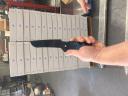
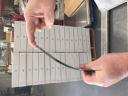
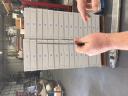
side view bent return to straight
It certainly pops back in the pictures above. We're not so interested in why our 1095 spring steel didn't pop back as to what degree this springy effect either does, or does not, have on edge rolling. At first blush, not much. Our interest is heightened by Mark's references to the "toughness" of steels. It would seem that this toughness could be equated, on some level, with "springiness" so it could be explained then why a knife steel edge that was hardened to HRC65 and tempered to HRC56 might seem to roll less than a HRC61 edge (because the HRC61 edge isn't as tough). We're crossing bridges here before we come to them but wait, maybe we're not. We just tested a "Japanese" knife that was made in China. Supposedly HRC60-62 and did show some indications of being a harder knife according to its sharpening characteristics (and price). The edge rolled slightly more than the Henkel 55-57 knife. Lots of really interesting stuff to be figured out here.
|