| Welcome, Guest |
You have to register before you can post on our site.
|
| Latest Threads |
Protocol for BESS measure...
Forum: Edge Sharpness Testing
Last Post: grepper
05-02-2026, 08:31 AM
» Replies: 8
» Views: 7,186
|
How to prevent the edge o...
Forum: All About Edges
Last Post: WI_Hedgehog
04-30-2026, 01:12 PM
» Replies: 6
» Views: 16,220
|
Blade Taper Angle? - Supe...
Forum: All About Edges
Last Post: WI_Hedgehog
04-30-2026, 01:01 PM
» Replies: 9
» Views: 26,290
|
Knife dulls overnight aft...
Forum: All About Edges
Last Post: WI_Hedgehog
04-30-2026, 09:01 AM
» Replies: 27
» Views: 85,889
|
The DILAGON: a DIY laser ...
Forum: All About Edges
Last Post: WI_Hedgehog
04-30-2026, 07:57 AM
» Replies: 27
» Views: 110,181
|
Used Rapid Edge Extend-A-...
Forum: Relevant General Discussion
Last Post: WI_Hedgehog
04-30-2026, 06:49 AM
» Replies: 3
» Views: 7,091
|
Saved old tool (Fun with ...
Forum: Relevant General Discussion
Last Post: WI_Hedgehog
04-30-2026, 06:43 AM
» Replies: 1
» Views: 2,876
|
Mike Brubacher has passed
Forum: Relevant General Discussion
Last Post: WI_Hedgehog
04-30-2026, 06:15 AM
» Replies: 2
» Views: 2,225
|
The definition of 'blunt'
Forum: Edge Sharpness Testing
Last Post: subwoofer
02-04-2024, 12:16 PM
» Replies: 2
» Views: 4,573
|
Avg BESS score for cheap ...
Forum: Edge Sharpness Testing
Last Post: grepper
04-24-2023, 12:04 AM
» Replies: 1
» Views: 5,154
|
|
|
| Deburring with a 3M Talc belt |
|
Posted by: grepper - 08-24-2017, 06:42 PM - Forum: Burr Removal Methods, Testing and Results
- Replies (3)
|
 |
Mr. Rupert most magnanimously sent me a 3M Talc belt to test to see how well it works for deburring. Thank you Mr. Rupert!
My main interest in testing it was to discover if it might be a more efficacious solution than the leather belt I normally use. The leather belt actually works very well for deburring, but it takes some practice and deburring must be done with care to remove burr on a toothy edge with a minimal amount of tooth smoothing. I keep searching for something I can just jam a blade into, do a couple of swipes and automagically have a nice, burr free edge with little or no smoothing of the toothy edge.
The surface of the talc belt is a fuzzy layer on a firm but slightly forgiving base. Unfortunately this particular belt has a manufacturing defect where one of the two but joints was not properly glued and filled in so the belt is held together by only the tape on the back of the belt. I was a little worried the thing might break, but because the Kally is a fairly slow 1x42 grinder generally the only damage done when a belt pops is that it is slightly startling. Here you can see the fuzzy surface of the 3M talc belt and the thickness of the subsurface.

For consistency I used a 150 grit Cubitron belt for sharpening and raised a fine little burr visible to the unaided eye.

My normal procedure when using the leather belt is to first make 2 or 3 light passes at the angle of sharpening. (1 pass = 1 swipe each side). I do this to make sure the burr is straight and not mashed down on one side of the edge. Then, holding the blade at almost 90° to the belt, very lightly swipe the length of the blade against the belt, doing this on both sides of the blade. This forces an almost 90 ° bend in the burr which I hope aids in stress fracturing the burr. Then I do a couple of passes at the angle of sharpening to bend the burr again, wipe it a few times on my jeans to clean the edge of dust and junk and I’m done. This generally does a pretty good job of burr removal with a minimum amount of smooth of the edge.
So, I did the same thing with the talc belt. Here is an image of the blade after the first couple of passes a sharpening angle. You can see that the passes at sharpening angle do a good job of getting the burr to stand straight from the edge.

Then I completed the procedure with the 90° swipes, sharpening angle passes and jean wipes. Here is the result. Still lots of burr.

Bailing on the talc belt, I used the leather belt. Here’s what it did.

A sharpness test on the PT50B after the leather belt yielded 145 gf. About what I would expect. Unless something has gone horribly amiss, this process almost always produces a 130 gf -150 gf edge. I’ve done this so many times now, and it works so consistently, I can pretty much predict the sharpness reading, but I always take one anyway cuz I just like using the PT50B. 
I suspect the talc belt is designed for polishing after loading it up with compound. I really had my hopes, but for burr removal, at least in this one test, I found it less effective than a leather belt. Alas, the search continues...
|

|
|
| Playing with a really coarse grit belt |
|
Posted by: grepper - 08-23-2017, 08:38 PM - Forum: All About Edges
- Replies (2)
|
|
The meanest, most gnarly and aggressive belt I have at the moment is a new 40 grit blue zirc belt. It’s a very sharp beast indeed, and not something I would want to bump my knuckles into when it’s moving. I was looking at the thing and thought, why not?
Using light pressure so I wouldn’t turn the blade into a toothpick, I sharpened it. It only took two light passes on each side to raise a nice burr. Then I did a quick job of deburring using a leather belt. Really I was just playing around and did not expect too much from the edge, so my sharpening and deburring effort was minimal at best.
The bevel does not exactly have a mirror finish. In fact, it has such deep scratches I actually used it as a fingernail file by sliding my fingernail along its length. It worked well as a file, smoothing the end of my fingernail and visibly removing fingernail material.
Here’s an image of the bevel. Gnarly, eh?

The edge felt very sharp, so I took three sharpness readings. To my surprise they were 90, 110 and 130 gf on the PT50B. Of course it hangs on my fingernail and feels very sharp to my fairly educated sharp detection fingers. It push cuts paper, melting through under its own weight. It shaves the hair on my arm. Melting through the skin of a ripe tomato is not a problem. Using only the weight of the knife, it easily slices through folded paper towel and everything else I tried. An interesting edge. Here’s an image of the edge.

The fun thing about sharpening with a very coarse grit is that it is very, very quick and automagically produces a nice, toothy edge. I noticed in Mr. Mark’s post, he was using a 60 grit Cubitron II at Sturgis. It’s interesting to me that once you start down the road of using coarse grits, it’s hard to stop. I have a couple 120 grit Cubitron II’s that I have not used yet, but now I think I’ll have to order a couple of those 60 gritters to play with too!
|
|
|
|
| Please provide feedback and suggestions |
|
Posted by: admin - 08-22-2017, 12:30 AM - Forum: Forum Assistance / Announcements / Suggestions / Feedback
- Replies (1)
|
|
In other forums I have seen categories like our Relevant General Discussion become a repository for 90% of posts, and I would like to address this so that our forum does not suffer the same fate. This is mostly due to having too few categories and/or categories that don't fit well with topics of discussion.
An excellent example are the posts regarding smooth and toothy edges, and recently the MicroForge edge. Some posts are in Relevant General Discussion, some are in Edge Retention Information and Testing.
When we started the forum, Edge Retention Information and Testing was designed to be just that, information about edge retention testing. General Relevant Discussion was designed to be for things that didn’t fit well into other categories. As our forum is evolving, it seems that now is a good time to revisit this issue.
I am wondering if we can improve our forum by adding a category or two, or even renaming existing categories to facilitate categorization of posts, and reduce General Relevant Discussion bloat while the forum is still young.
Too many categories is just confusing. Too few categories leads to General Relevant Discussion bloat.
Possible categories might be:
All About Edges
Deburring Information and Methods
Good forum design is more difficult than it first appears, and we a completely open to changes as the forum grows and evolves.
We designed this forum for our members, and wish it to be as friendly and easy to use as possible. Any and all suggestions would be greatly appreciated!
Thanks! 
|
|
|
|
| Surface finishing belts and deburring |
|
Posted by: grepper - 08-20-2017, 10:40 PM - Forum: Relevant General Discussion
- Replies (16)
|
|
The first time I had ever heard of using a surface finishing belt (Scotch-Brite) in connection with sharpening or deburring was on this forum. Because of the unique surface of these belts, it kind of sat in the back of my mind as something interesting, especially in connection with deburring.
The reason I thought it might work for deburring is the odd, almost sponge like and sort of forgiving surface. My reasoning was that this unique surface may grab at the burr and therefore aid in removing it.
Looking at the surface with a 10 X loupe, it looks sort of like a sponge. I took this image with a digital camera:

I decided to take a little closer look-see at these wonderful belts, and I was surprised to behold an almost alien brain synapse like structure. How’d they ever come up with that I thought! Once you see what’s really going on, it’s much easier to understand how they can create a beautiful satin finish on metal surfaces.
The surface appears to be comprised of some sort of fiber, or possible wire, with globs of colored adhesive embedded with abrasive particles. Methinks it’s pretty cool.

But, if you recall, my original purpose for checking this out was to find out if surface finishing belts can be used for deburring. To this end I did the following:
I sharpened a blade and did a good job of removing the burr so I was starting with a clean edge. The black line on the right of these images is a marker line for reference. Two sharpness tests with the PT50B approximately 10 mm from the line were 130 gf and 125 gf.

Then I did three passes on one side of the blade and then three passes on the other side of the blade with an extra fine blue Scotch-Brite belt. Like any other abrasive belt, this raised a burr. With the burr, two sharpness readings were 435 gf and 575 gf. Here is an image of the blade with the burr created by the Scotch-Brite belt. The burr is clearly evident.

Then I deburred the blade. Two sharpness tests after deburring were 150 gf and 140 gf. Here is an image of the blade. Apparently I failed to completely remove the burr as there appears to be a small amount of burr remaining which probably accounts for the slightly higher sharpness reading compared to the blade when I started.

Then it struck me that the burr created by the Scotch-Brite belt in this test was very similar to the burr pictured in my previous post ( http://bessex.com/forum/showthread.php?t...72#pid1172 ) after using the Scotch-Brite belt. They appear very similar in both structure and size. Just guessing, but I think there is a possibility that the burr from the previous post was actually created by the Scotch-Brite belt when I attempted to use it for deburring. Here is a comparison of the two.

I was really hoping that a surface finishing belt might be the magic sauce for burr removal, but at this point I’m skeptical. I’ll leave it up to you to decide.
As always, this was just one test. It is neither extensive nor conclusive. Nonetheless, that is what happened and what I observed. I guess it's another take from it what you will kind of thing.
|
|
|
|
| How to Create a Toothy Edge Without Really Trying |
|
Posted by: grepper - 08-17-2017, 11:17 PM - Forum: Edge Sharpness Testing
- Replies (2)
|
|
Deburring without smoothing a toothy edge can be difficult and time consuming. If you don’t care about tooth, deburring is easy, but if you do it’s another animal entirely and can be exasperating. Frankly I just grew weary of the effort, so I started considering ways to circumvent the problem.
Common wisdom when sharpening is always to start with a coarse abrasive and then go finer, but then I thought, what if I do it bass ackwards? The idea is to create an edge so toothy as to withstand deburring with wild abandon.
I did all of the following on the Kally.
So, I sharpened a blade with a wonderful 150 grit Cubitron belt, and did a quick, sloppy job of deburring with a leather belt. Now I would just skip that deburring step. Really no need for it. Now I might even skip the 150 grit part too. Then I did a couple of passes with an 80 grit Zirc belt which I normally only use for hogging off metal because it is so sharp, coarse and aggressive.
Then I just deburred with the leather belt with reckless, wild abandon as though I didn’t care about preserving toothyness and my only concern was complete burr removal.
I didn’t spend much time sharpening or deburring. Because all of the abrasives were nicely coarse and aggressive, sharpening took very little time. And because I went at it like I didn’t care, deburring was quick, easy and effective. The best part is that it was so fast and easy it didn’t leave me enervated from being all delicate messing around deburring.
Guess what? It worked. Final sharpness is 145 gf on my PT50B.
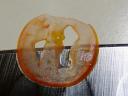
Here is an image of the edge. Completely of deburred, gnarly and toothy! It easily slices a single layer of dry onion skin placed flat on a cutting board.

It melted through the skin of a Moby Grape tomato:
|
|
|
|
| The Toothy Truthy- Sturgis Rally 2017 Event |
|
Posted by: Mark Reich - 08-14-2017, 12:27 PM - Forum: All About Edges
- Replies (10)
|
 |
As some of you know, the Sturgis Rally, or more directly, the Legendary Buffalo Chip Campground, is a significant part of my year. We sharpen tons of knives. It's one of the things we do to generate interest, not make money. We only charge a couple bucks. I can't believe how many friends we've made, or how many people only need to sharpen their knives once/year.
Anyway, I decided to do nothing but super toothy edges this year, and I think we did great. I've taught two of my crew to sharpen, so I can socialize more. This year I brought a few Kallys, a new low speed Viel, and what has proven to be the secret sauce- 3/8" diameter, 10" long, DMT 625 grit Dia-Sharp rods.
I let my friends make up their own minds on how they want to sharpen. Obviously, the difficult part is deburring. I give them all the training and tools they could ever need, and let them develop their own system.
By the end of the second night, we all realized the diamond rods totally remove the burr in about two strokes per side, while leaving almost all of the tooth of a 120 grit belt. The customers were happier than ever, and it takes me about 30 seconds to sharpen and deburr almost any blade.
Interestingly, we figured something else out. When I sharpen a knife in 30 seconds, people don't tip. They are amazed with their knives, but they figure $2-$3 is plenty for something that looks so easy and takes so little time.
In previous years, I used to refine the the burr away. It takes way Way longer, and produces a much smoother edge, capable of tree topping with virtually any knife. Guys were amazed. It was normal to have a pile of knives to sharpen. At times there could be as much as a 30 minute wait to get their knives back to them. I'd rarely get less than $5. $10 wasn't uncommon. Some guys tipped $20 or more.
Now we are giving them a much more effective edge in a fraction of the time it used to take, but we barely made half as much money off sharpening this year.
Sure, I could just raise the price, and I doubt anyone would balk at $5. After all, that was previously the norm when it took 2 or 3 minutes or whatever, but 75% of my time was just completely refining the burr away.
With diamond or ceramic sticks, it's very cool to watch a big ol' hairy burr just fall off the edge like tinsel in a few seconds. This is far from new to me. I started making the rod holders many years ago, and they've always worked incredibly well. I didn't ever use them at events, because I knew guys would think that was "cheating". It does seem too quick and easy.
|
|
|
|
| Warning - Don't use Photobucket for hosting forum images |
|
Posted by: grepper - 08-07-2017, 02:24 PM - Forum: Relevant General Discussion
- Replies (15)
|
|
My apologies.
I had recommended to members of this forum to use Photobucket for third party hosting of images in forum posts. I retract that recommendation.
For years Photobucket used to be free and millions of users worldwide hosted images on Photobucket and linked to those images for forum and blog posts and displaying images in web sites. Now Photobucket has changed their policies and are demanding a ransom payment of $399.00 per year. If you don't pay up, all previously linked to images in forum posts are blocked.
I have many posts in forums that are now ruined.
Photobucket's excuse? From their website:
"Moving forward, new and legacy free account users will NOT have third party hosting available."
Additionally, it appears that even if you were a paying member but let your account lapse and don't continue paying indefinitely, your linked to images will be blocked:
"If you were a Plus Account subscriber in good standing as of June 1, 2017,
you will continue to have all the privileges you have enjoyed including 3rd
Party Hosting until December 31, 2018 as long as you maintain your
subscription."
Here is an example of what Photobucket has done. I remember making that post and it took a considerable amount of time and effort. Now ruined by Photobucket. I posted this more than two years ago. Now Photobucket is demanding a ransom payment??? Ironically it is a post I made attempting to assist fellow members on how to post images:
https://www.tormek.com/forum/index.php?t...2#msg11402
And check this out:
https://www.dpreview.com/news/6875746538...s-of-users
https://www.google.com/search?hl=en&as_q...as_rights=
|
|
|
|
|