


02-27-2018, 10:51 AM
Thank you me2 for the explanation and definition of toughness. We just don't know. It simply perplexes us that so little force is required to permanently roll the edge. Keep in mind that the force we are applying is considerably less than the weight of the knife itself. We are applying that force in a very localized manner (the radius of a .75 inch diameter linear ball bearing) but still, nothing remotely close to cutting a frozen hot dog into two pieces. One possible explanation is that we are just crappy sharpeners and we advance that theory not just as some self effacing comment but as a genuine possibility. Another possibility is that edge apexes, via the sharpening process, undergo structural transformations that we don't yet understand.
As an aside to this conversation, we tested a different Henkel knife. One with a much thinner blade than our chef's knife. We look at several different things but one of the things we are beginning to look at is the relationship between initial sharpness level and the amount of roll. So far, duller edges definitely roll less...and significantly less. This is not to say, however, that duller edges test sharper than their sharper counterparts after rolling. They do begin to test very similarly though post rolling.
The method that we currently use to roll edges produces very undramatic microscopic pictures from a side perspective. There is little to see. We have begun to look at these edges "edge on" though with some success. Here's a couple of examples:

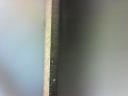
Beginning BESS Score 152 Beginning BESS Score 360
This is the same knife edge at two different points on the edge. In the 152 picture we think that we can see the light reflected off the rolled edge and in the 360 picture we couldn't. This makes sense to us because the 152 edge rolled about 200 points while the 360 edge rolled only 60 points.
Well we've managed to move this conversation off topic so we're going to go ahead and post here but also pick up the last two or three posts and post them in the Rolling Edges thread as well to preserve continuity.
As an aside to this conversation, we tested a different Henkel knife. One with a much thinner blade than our chef's knife. We look at several different things but one of the things we are beginning to look at is the relationship between initial sharpness level and the amount of roll. So far, duller edges definitely roll less...and significantly less. This is not to say, however, that duller edges test sharper than their sharper counterparts after rolling. They do begin to test very similarly though post rolling.
The method that we currently use to roll edges produces very undramatic microscopic pictures from a side perspective. There is little to see. We have begun to look at these edges "edge on" though with some success. Here's a couple of examples:
Beginning BESS Score 152 Beginning BESS Score 360
This is the same knife edge at two different points on the edge. In the 152 picture we think that we can see the light reflected off the rolled edge and in the 360 picture we couldn't. This makes sense to us because the 152 edge rolled about 200 points while the 360 edge rolled only 60 points.
Well we've managed to move this conversation off topic so we're going to go ahead and post here but also pick up the last two or three posts and post them in the Rolling Edges thread as well to preserve continuity.