


RESULTS:
We've finished most of our basic tests and are compiling the information. We thought it best to release the findings in pieces as opposed to one volume. Below you will find the results of one test.
If you recall, we did a quick and dirty test some weeks ago on two samples. One HRC50 edge and one HRC62 edge just to see if our pre-sharpen and post heat treat experiment had proved successful. The tests below use two different HRC50 and HRC62 samples than the ones tested earlier. They did yield very similar results with the exception of one factor represented in the HRC50 samples.
We don't recall discussing this previously but we did run a little side experiment here. As you recall, these are double edges samples and we treated each edge differently; while both sides (edges) were ground until a burr was present (pre heat treat), we performed preliminary burr removal on only one edge. This was just an experiment to see if a sharper edge resulted from pre burr removal as opposed to post heat treat burr removal. In some cases, this seems to made a lot of difference and others, minimal difference.
HRC50 blades seem to be the case that makes the most difference. Post burr removal edges in their case seem to result in much sharper edges. Here are the samples tested:
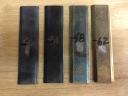
The chart below represents (4) samples with two edges each. our #5,#7,#10,#12 and HRC50-62 respectively. The chart header contains the following legends PRE BURR (burr removed prior to heat treat), POST BURR (burr removed after heat treat) and final sharpness level achieved for each. Then POST SET (sharpness reading after edge rolling) and TOTAL ROLL (difference between initial sharpness and POST SET reading). Only the POST BURR edge was subjected to SET testing. The POST BURR sharpness level was used in calculating TOTAL ROLL. These test results report only the POST SET measurement after one SET cycle (5 times up and back).
We found it interesting that we were only able to achieve a sharpness level of 525 with the PRE BURR HRC50 sample. Not totally surprising though because we were only able to achieve 420 with the earlier HRC50 sample we reported. Note the difference between sharpness levels in the PRE BURR and POST BURR edges of the HRC50 sample though. While this trend continued in the balance of the samples it was not nearly as pronounced. All this has little to do with edge rolling but it is an interesting aside.
Please keep in mind that these samples have not been sharpened post heat treat, only deburred with a plain leather surface. Post heat treat sharpening results are likely the next set of results that we will report.

It is interesting here that results indicate harder steels seem to be less subject to roll by 10-20% than the softer samples. This reverses or, at the least, mitigates the trend that we had been seeing in production cutting edges. This is true with these results even though the edges began somewhat sharper. Our previous sharpened edge results have shown us that the sharper the edge, the greater the roll through Phase I tests (one cycle). Multiple cycle tests conducted by KnifeGrinders have seemed to mitigate this disadvantage. It is plain for us to see that burr removal is easier with the harder steels and results in somewhat sharper edges as well.
We've finished most of our basic tests and are compiling the information. We thought it best to release the findings in pieces as opposed to one volume. Below you will find the results of one test.
If you recall, we did a quick and dirty test some weeks ago on two samples. One HRC50 edge and one HRC62 edge just to see if our pre-sharpen and post heat treat experiment had proved successful. The tests below use two different HRC50 and HRC62 samples than the ones tested earlier. They did yield very similar results with the exception of one factor represented in the HRC50 samples.
We don't recall discussing this previously but we did run a little side experiment here. As you recall, these are double edges samples and we treated each edge differently; while both sides (edges) were ground until a burr was present (pre heat treat), we performed preliminary burr removal on only one edge. This was just an experiment to see if a sharper edge resulted from pre burr removal as opposed to post heat treat burr removal. In some cases, this seems to made a lot of difference and others, minimal difference.
HRC50 blades seem to be the case that makes the most difference. Post burr removal edges in their case seem to result in much sharper edges. Here are the samples tested:
The chart below represents (4) samples with two edges each. our #5,#7,#10,#12 and HRC50-62 respectively. The chart header contains the following legends PRE BURR (burr removed prior to heat treat), POST BURR (burr removed after heat treat) and final sharpness level achieved for each. Then POST SET (sharpness reading after edge rolling) and TOTAL ROLL (difference between initial sharpness and POST SET reading). Only the POST BURR edge was subjected to SET testing. The POST BURR sharpness level was used in calculating TOTAL ROLL. These test results report only the POST SET measurement after one SET cycle (5 times up and back).
We found it interesting that we were only able to achieve a sharpness level of 525 with the PRE BURR HRC50 sample. Not totally surprising though because we were only able to achieve 420 with the earlier HRC50 sample we reported. Note the difference between sharpness levels in the PRE BURR and POST BURR edges of the HRC50 sample though. While this trend continued in the balance of the samples it was not nearly as pronounced. All this has little to do with edge rolling but it is an interesting aside.
Please keep in mind that these samples have not been sharpened post heat treat, only deburred with a plain leather surface. Post heat treat sharpening results are likely the next set of results that we will report.
It is interesting here that results indicate harder steels seem to be less subject to roll by 10-20% than the softer samples. This reverses or, at the least, mitigates the trend that we had been seeing in production cutting edges. This is true with these results even though the edges began somewhat sharper. Our previous sharpened edge results have shown us that the sharper the edge, the greater the roll through Phase I tests (one cycle). Multiple cycle tests conducted by KnifeGrinders have seemed to mitigate this disadvantage. It is plain for us to see that burr removal is easier with the harder steels and results in somewhat sharper edges as well.


