Posts: 504
Threads: 55
Joined: Feb 2017
Thomas,
I think the new computer based programs are marvelous. I use them every day. There are several programs I want to learn, among them Sketch Up and Adobe Photoshop.
Before I started working with a computer, I had a very established program. My "word processor" was pencil and paper. My photographic technique had been honed for decades. I was very proficient with black and white photography, both in the field and in the darkroom. I had used the same film and developer as well as the same cameras, for many years and knew them intimately. I never had to relearn anything when the next version was annouced.
I made fewer images and prints, however they were just as meaningful as any I make digitally today.
Today we seem obsessed with quantity and speed. Often casual photographers have made many thousands of saved images stored on their latest cel phones. By comparison, Ansel Adams, one of our finest photographers, made around ten thousand negatives in a very long career.
I recently spent two days in the hospital. I had no time to pack for this. All I brought with me were two small pocket size spiral notebooks. I used the quiet time to compose my thoughts and work through a belt grinder project. The time was peaceful and productive. I want to find a balance between the fast pace of the computer and my slower, more contemplative natural pace. I think that is one reason why I enjoy sharpening.
Ken
Posts: 219
Threads: 36
Joined: Mar 2017
Reputation:
0
That's a great idea Thomas. We'll have a look at the program you mentioned and see if there is still time for one more trick to be learned by this bunch of old dogs.
Posts: 166
Threads: 11
Joined: Mar 2017
Ken S, we have veey similar background I think. I drew, sketcher and painted when I was younger. I use pencil and paper, made allmänt drawings by hand - until I found Sketchup. Today I do all construction misstakes in Sketchup, not in my workshop

I atill have my old Leicaflex camera, I used Tri-X mostly and also diapositive and I have thousends of old pictures saved..... My plan is to sort them and use the beat of them...but I think that my children must do that for me when I am gone
i never have the time for it it seams...
Sketchup is a easy program to learn - and also funny to learn becouse it is a 3D program. You can swing everything around - and if you draw a house, you can walk in to the house and look around. My brain like all the possibilities this program gives. I learn it with the monkey method, learning by doing and learning by misstakes
Thomas
Posts: 166
Threads: 11
Joined: Mar 2017
Mike, look at the program, play with it, try different tools - and I think you will enjoy it.
I can send you a file of something you can use to start with if you like
if so, I need your email adress.
Thomas
Posts: 361
Threads: 11
Joined: Mar 2017
Mike, in the attached picture you can see knives on my sharpening program today. The largest knife is 12.5"long. It would be a great opportunity to test your deburring apparatus!
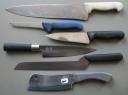
Please keep us informed about its progress, I like your deburring device very much!
Jan
Posts: 160
Threads: 0
Joined: Mar 2017
I agree with Jan. That burr removing machine looks like pure genius to me. Lots of different possibilities for belt material too but I guess if the rubber O rings do the job then why mess with success? Flipping the knife back and forth takes a lot of time and effort. This is just a really cool way to speed up, for me, is a tedious part of sharpening.
I'm all over this Tommy Wheel project. I understand that sandstone grinding wheels might not have been that efficient. I'm all for preserving things in the old way but I like things to work as well. A modern abrasive wheel would probably just make this machine fly. Is there any way that EOU is considering making more than just one of these wheels? If so, put my name on the list please. Put a way to remove burrs in the mix and you have a real machine --- and a way to drop a few lbs. in the process!
Posts: 592
Threads: 26
Joined: Mar 2017
Reputation:
0
Wow! A deburring machine sounds like science fiction!
This could be HUGE!
Posts: 166
Threads: 11
Joined: Mar 2017
04-24-2018, 12:15 PM
(This post was last modified: 03-04-2021, 12:57 PM by Edgepal.)
https://i.ibb.co/JRQ2Wb6/image.jpg
This is a boataxe from younger stone age, about 3000 years old - and some parts of its owner at the time this axe was in use.
Tye name comes from the axe design, it looks like a boat.
This type of axe was first knacked out coarse and then grinded to perfektion. We have found a lot of this type of axe - and it have been discussed during centuries what it was good for and what it can perform - ans the answer is probebly - nothing, it was probebly a sign of some kind.
For long time historians think it was a battle axe, made to crush sculls. It is still a possibilitie - but why have a special axe for just sculls? Cermonial human offerings by crushing sculls? Perhaps - but we cannot find and crushing sculls with holes from this type of axe...
Any way, it is beutiful made, a piece of art.
Thomas
Posts: 166
Threads: 11
Joined: Mar 2017
04-24-2018, 12:26 PM
(This post was last modified: 03-04-2021, 01:00 PM by Edgepal.)
https://i.ibb.co/6myfPgD/image.jpg
To grind stone stone age people use other stones - and we have hundreds, perhaps thousends, of this old grinding stones left from that time. They can be fond in free standing stones, on stonesground and on mountains.
Quartz sand and water was used to grind out their forms and edges. To make the hole they use a piece of wood like a drill, Quartz sand and water - and a lot of time.
A old name of this grinding slits is "sword grinding slitses" in Swedish: svärdslipningsrännor.
Thomas
Posts: 361
Threads: 11
Joined: Mar 2017
04-24-2018, 02:16 PM
(This post was last modified: 04-24-2018, 02:27 PM by Jan.)
Thomas thanks for your interesting pictures. It is a good food for thought.
Sometimes ago I was asked to make a ritual knife with a stone handle. It was necessary to drill a 1/3" hole into the stone handle. I used the wet grinding grit worn from a Tormek grindstone as a cutting fluid and it worked fine. The knife is not finished yet but the handle is more or less done.
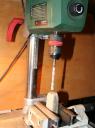
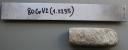
The grinding grit residuum cannot be put down to the sink because it would cause plumbing problems.
Jan