


03-09-2018, 11:52 AM
Sorry for the delay between posts but we haven't just been twiddling our thumbs. If you have been following here then you know that the way we measure the extent of the roll on an edge is with an edge tester. The edge tester interprets the rolled edge as being dull. The duller the edge reading the greater extent of the roll. So what we have then is an interpretation of the roll, not a direct or physical measurement of the roll. We decided to take a shot at experimenting with direct measurements of the roll. We decided to do this for two reasons; (1) We really had no good idea about how far the roll extended laterally from the apex of the edge (we suspected in the .001" to .003" range). If we could answer this question more precisely then we could more accurately relate edge testing results to the physical dimensions of the roll and (2) It would give testers one more tool in analyzing and understanding the differences between steels and sharpening methodologies. One thing that we have always understood though is that the edge tester readings are where the rubber meets the road. It is fine to tell someone that an edge has rolled 42 microns but we know that the next question will always be "So fine, but how does that affect the cutting or slicing ability of my edge?". That is the question that the edge tester answers most eloquently and precisely. We used an adjustable test stand, a variance indicator capable of 1 micron accuracy and a specially constructed fixture designed to locate and relocate the knife in a repeatable fashion.
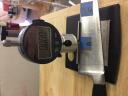
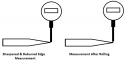
So the process was simple enough, measure the sharpened edge - zero the gauge - remove the knife from the stand and then roll the edge - place the knife back in the measuring fixture and measure the difference. Sounds simple enough but it didn't turn out that way for a couple of reasons. First, a 300 point roll i.e. begin 150 end 450 BESS produces a lateral protuberance that measures something under .001". 300 points of roll is a sizable roll and with only 25 microns in .001" that doesn't leave us with much scale or room for error. Second, repositioning the edge after rolling "accurately and repeatably" is a monumental and time consuming task. We were left with a much clearer idea of how small these rolls actually are but that's about it.
We are currently producing 5 of our rolling test stands for distribution to our member testers. It looks as if the data is going to have to be gathered by their PT50A's B's and KN100's because it just doesn't look like a high-tech yardstick is going to get it.
So the process was simple enough, measure the sharpened edge - zero the gauge - remove the knife from the stand and then roll the edge - place the knife back in the measuring fixture and measure the difference. Sounds simple enough but it didn't turn out that way for a couple of reasons. First, a 300 point roll i.e. begin 150 end 450 BESS produces a lateral protuberance that measures something under .001". 300 points of roll is a sizable roll and with only 25 microns in .001" that doesn't leave us with much scale or room for error. Second, repositioning the edge after rolling "accurately and repeatably" is a monumental and time consuming task. We were left with a much clearer idea of how small these rolls actually are but that's about it.
We are currently producing 5 of our rolling test stands for distribution to our member testers. It looks as if the data is going to have to be gathered by their PT50A's B's and KN100's because it just doesn't look like a high-tech yardstick is going to get it.


 Bud we'll test the knife and then decide. We simply don't want to get out front of our member testers.