Posts: 500
Threads: 38
Joined: Mar 2017
We've always said that we've learned far more from our customers than they have from us so we're back to the well here. This subject concerns one of our industrial customers who developed questions concerning sharpening protocols after purchasing one of our ID75A instrument systems. They provided us with samples of both new and used edges that are used in one of the their many cutting/slicing operations. The following picture was taken, by us, of one of their used blades. The blade is used in, what we would term, a planing operation. The blades are used to plane the surface of flat plastic bars. These blades are hardened tool steel, .125 inch thick and single bevel ground at 30 degrees. The customer refers to these blades as "skives". The following is an optical microscope image of the "flat" or backside of the blade.
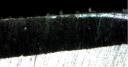
Not so pretty. We think that this edge has several problems but the question that we would like to pose here is this one; It would appear that the edge has rolled and that it has rolled toward the flat side of the blade (skive). This roll is bad enough that a fingernail can be hooked on it. Is this roll direction normal? From an apex structure standpoint it seems as if it might be but from an application standpoint (planing) it seems unlikely. Certainly this roll direction seems to be real deal killer in terms of a planing operation.
We're hoping that our woodworkers out there might be able to lend the benefit of their experience to this question.
Posts: 361
Threads: 11
Joined: Mar 2017
12-07-2017, 03:42 PM
(This post was last modified: 12-07-2017, 04:30 PM by Jan.)
Mike,
do you know if the blades were used in bevel up or bevel down regime? This would help to decide whether the edge rolls in the expected direction.
In my understanding the blade was used in the bevel up regime.
Jan
Posts: 500
Threads: 38
Joined: Mar 2017
12-07-2017, 04:22 PM
(This post was last modified: 12-07-2017, 04:48 PM by EOU.)
Don't know for certain Jan. We assumed bevel up but its a good question and we're going to find out from the customer.
30 degree bevel side up.
Posts: 500
Threads: 38
Joined: Mar 2017
Not certain how that post formatted itself - anyway Jan, bevel side up.
Posts: 160
Threads: 0
Joined: Mar 2017
I just purchased a pre-1960 Stanley plane at an auction. Dug it back out and looked at the blade with a loop. It's dull for sure (400 to 780 BESS) and those measurements tell me the edge is probably rolled in spots or probably just rolled worse in some spots than others. If it was a just sharpened edge I'd say it had lots of burr on it. The edge isn't rolled badly all the way across that I can see but where I can it sure seems to be rolled toward the bevel side. When I put on the strop it drags worse on the bevel side than the flat side. I'm going to take it to work tomorrow where we have digital microscopes and have a look. If I can get a picture that shows something I'll put it up here tomorrow night.
Posts: 361
Threads: 11
Joined: Mar 2017
12-08-2017, 08:44 AM
(This post was last modified: 12-09-2017, 04:05 AM by Jan.)
Mike, thanks for confirming that the blades are used with the bevel side up. I am not surprised that the edge rolls towards the flat side of the blade.
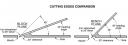
The edge rolls because the steel is not able to support forcing the cutting edge into the material to be cut. The cause of this weakness can be seen in the properties of steel and/or in bevel angle and bedding angle geometry.
For work with difficult material the sum of the bevel angle and bedding angle can reach as much as 60°.
The simplest way to correct this issue is to sharpen a microbevel or to regrind the blade to a higher bevel angle, e.g. 35° to 40°.
An alternative way is to use blades made from steel with better edge retention and impact resistance. Blades made from some powered metal alloys remains sharp much longer than blades made from high carbon tool steel O1.
Jan
Posts: 160
Threads: 0
Joined: Mar 2017
I snuck into work today and had a look with the microscope at my planer blade. I don't know enough about it to figure out what I'm looking at because it looks like it might be a burr on both sides to me. I know nothing about the history of this blade so perhaps this isn't even helpful. I sent the pictures to Edge On Up this evening. If they can learn something from them then good. Maybe they will post the pictures and their thoughts on them.
Posts: 500
Threads: 38
Joined: Mar 2017
Here are the pictures that Bud forwarded to us. We've put them together in one picture so that they are more easily compared. The top edge is back of the blade and the bottom picture the bevel side. We can see the source of Bud's consternation here. The bevel side edge does appear as if it might have rolled in the direction of the bevel. The backside edge looks as if one might be looking at an edge that has just been ground and before any burr removal has been attempted. Of course, this can't be the case because Bud says this is a well used edge. We suspect that what appears to be burr on the backside is actually just a very small bevel. In any case, the backside picture doesn't appear to show a rolled edge. Not to us anyway. Does anyone else have a competing analysis they'd like to share?
Can't help with your questions Grepper. Perhaps Bud will be back with answers. Thank you very much to Bud for the pictures and the help on this question.