


I have to admit being in somewhat of a quandary as to how to test the MicroForge edge. After a bit of head scratching, I decided to compare it to a smooth, polished edge because that is so commonly used.
I ground a blade, using 400, 600, 900 grit belts and finished with a 9 micron 3M Microfinishing Film belt. Deburring was accomplished with the rough side of a leather belt. Dividing the blade in thirds, three sharpness readings revealed 120, 130 and 125 gf. Good enough.
The bevel was shiny, very reflective and smooth. The blade performed as you would expect; shaved hair, effortlessly pushed cut paper and melted through tomato skin. I was adjusting it under the microscope and realized that at some point I must have brushed the edge as I noticed evidence that I was suffering some minor epidermal leakage. I’m always amazed at how easily that happens.
Here is an image of the bevel using side lighting to avoid reflection. In other images that follow you will see the bevel is actually a mirror finish and difficult to photograph due to reflection.

Using moderately firm pressure and starting from the tip as per the included instructions, I pushed the first half of the blade through the MicroForge slot in the handle, leaving the other half of the knife untouched. It passed through so smoothly and with so little tactile feedback my initial impression was that probably I had not used enough pressure and that not much had happened. However, a quick look at the blade revealed I was laboring under a delusion.
Much to my surprise it had created a very fine, toothed edge that reminded me of a fine tooth, metal cutting hacksaw blade only with much smaller teeth. “Micro” in MicroForge is apropos. Closer examination reveals the hacksaw analogy is not exactly correct as it doesn’t create a row of teeth, but small depressions regularly spaced along the edge of the blade. The ramifications of his distinction gained apparent significance during testing.
I had read a review that stated that drawing the blade over the edge of a piece of paper had a “zippy” feeling. Well, I couldn’t resist, and sure enough it felt “zippy”. I am at a loss for a better adjective. It’s easier to imagine how it could feel “zippy” after checking out these images.

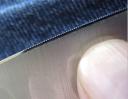
Here is a closer look at the edge fresh from the MicroForge. The last image shows the edge against the open jaws of a Mitutoyo caliper open to 1.00 mm. Sorry about the blurry image. Attempting to maintain focus and get it all within the FOV proved challenging. Note how the steel is pushed up around the edges of the depressions. I was surprised that simply pulling the blade over the little MicroForge roller can push steel around like that. It appears to me that the depressions are not ground, but rather the steel is just pushed to either side. Amazing.


I then took six sharpness readings within the MicroForged area of the blade; 165, 145, 175, 195, 230, 213. Recall before the MicroForge the blade started at 120, 130 and 125 gf. I took six readings because I didn’t know if the test media landed inside of the depressions or on the edge between depressions, so I thought more readings might be instructive. I still don’t, so your guess is as good as mine.
Following the instructions, I then performed 10 light alternating strokes on the smooth sides of the ceramic rod. The Ceramic rod is more abrasive than it feels, and this action appears to have reduced the raised, deformed bulges of steel around the edges of the depressions. You can also observe the scratches in the bevel from the ceramic rod and some minor burr creation reflecting light on the edge that could account for the generally higher sharpness readings even if the test media was contacting the blade between the MicroForge depressions.

I then took six more readings of the MicroForge section; 185, 220, 290,330, 235,260. The readings indicate using the ceramic rod slightly dulled the edge.
So, how did the blade perform? To test that I sliced ripe but firm Moby Grape tomatoes and both the MicroForged section of the blade and the smooth part sliced effortlessly. The only difference was that I could feel a very slight resistance as the Microforge section grabbed at the skin, while the smooth part of the blade just melted through. The difference was very, very slight and even difficult to detect. Suffice it to say that both sliced the tomatoes effortlessly and admirably.
I thought this to be unremarkable as the blade was extremely sharp to begin with. However, the MicroForged part tested as less sharp but it had the advantage of being “toothy”. About the only thing I could derive from testing so far was the MicroForged blade seemed to cut about as well as the original edge.
While not unexpected, it was a bit frustrating because the test had not demonstrated any significant differentiation between the MicroForged edge and the original edge. Work Sharp states, “MicroForge technology creates a longer lasting, more durable edge…” So, to test that claim I reduced a cardboard box to a pile of shredded smithereens.
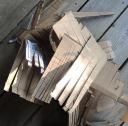
After this abuse of the edge I took three sharpness readings of the smooth section of blade and three of the MicroForged section. Smooth: 270, 240, 315. MicroForge: 400, 440, 415.
Now here is the interesting part. Even though the smooth section of blade tested as sharper, the MicroForged section seemed to slice tomatoes maybe ever so slightly better. That said, I should emphasize the difference was not really remarkable. Both sections of the blade were able to slice the tomatoes, both required a significant amount of slicing action to penetrate the skin, but it seemed the MicroForged edge performed, maybe, just ever so slightly better. It was a close call however, and I had to do a lot of slicing to arrive at that conclusion. Nonetheless I guess I’ll give the edge to the MicroForge. Is there a pun here?
That really surprised me. I had decided to use tomatoes for testing because I thought the toothy quality of the MicroForge blade would excel and perform much better tearing through the skin of a tomato than even a slightly rolled and dull smooth edge. I wondered how the performance difference could be so diminutive and unremarkable.
You may recall that earlier I stated, “Closer examination reveals the hacksaw analogy is not exactly correct as it doesn’t create a row of teeth, but rather small depressions regularly spaced along the edge of the blade. The ramifications of this distinction gained apparent significance during testing.” It was at this point I started wondering if the sections of blade between the MicroForge depressions affected how the blade performed significantly more than the MicroForge depressions did. In other words, the depressions didn’t seem to have nearly as much influence on the performance of the edge as I would have expected. I would have expected the MicroForge edge to have performed more like a conventional serrated blade, and as the blade dulled it would continue to cut significantly better than the smooth blade, but oddly, that was not what the tomato cutting was indicating.
The interior edges of the little depressions are more protected from dulling that the flat, exposed edge between them and should, in theory, remain sharper. But how much influence does this have on cutting performance? To test this and to save me from having to spend the afternoon obliterating cardboard boxes, I dragged the blade over 180 grit sandpaper 5 times as though I was trying to cut it into strips. This efficiently and pretty evenly dulled the entire flat exposed areas of the blade and, in theory at least, should have impacted the interior of the depressions to a much lesser extent if at all.
Indeed, the sandpaper performed admirably. I took three sharpness readings in the smooth area of the blade: 820, 1090, 950 gf. For the MicroForged area, 950, 825, 975.
Then I tried slicing more tomatoes. As far as I could tell the entire blade cut equally poorly. It was difficult to slice through the tomatoes without crushing them. It took a lot of gentle slicing to penetrate the skin and every attempt to expedite the process resulted simply mashing the tomato rather than cutting it. Here the smooth edge seemed to very slightly outperform the MicroForged edge. That said, I should emphasize the difference was not really remarkable. Both sections of the blade were able to slice the tomatoes, both required a significant amount of slicing action to penetrate the skin, but it seemed the smooth edge performed, maybe, just ever so slightly better. I had to do a lot of slicing to arrive at that conclusion. The difference was that close. Sound familiar? It is, except in this case I guess I’ll give the edge to the smooth edge.
Purely speculating, I am guessing that the areas of the blade between the MicroForge recesses are responsible for the majority of cutting performance of the blade. Therefore, initial blade sharpness before applying the MicroForge is of paramount importance. This seems reasonable considering that even after applying the MicoForge the majority of the edge is basically untouched. I say basically untouched because both observation and sharpness readings seem to indicate that the roller also touched the part of the blade between the indentations and affected the sharpness of those areas.
Here is an image of the final smooth area of the blade. You can see how the edge rolled into one, long, dull roll of steel. I believe this continuous, contiguous rolling of smooth edges is illustrative of why smooth edges suffer general performance degradation more quickly than toothy edges which roll more unevenly.

Here is the final image of the MicroForge edge. The indentations are still there, but the area between is rolled, rounded and dull. Surprising to me is that the depressions seemed to have little affect when slice cutting.

This was obviously a very limited and quick attempt to evaluate the MicroForge edge. Is this a fair test of how a MicroForge edge would perform in real world use? In some ways I think yes, in others no. The part of the testing before the sandpaper seems reasonable, but running the blade over sandpaper is extreme and probably not representative of any type of reasonable real world use. A far superior, more reasonable and informative test would be for someone like Mr. Max The Knife to get these edges into a commercial kitchen and evaluate the performance over a few weeks of daily use. I am looking forward to other forum members impressions after putting the tool through its paces.
In closing, I am not going to offer any personal opinions or attempt to form any conclusions here other than to say that is what I did and observed. Verily, your mileage may very well vary.
This was just one limited test and in no way extensive, comprehensive or conclusive.
-------------------------------
An addendum:
My apologies. I forgot to include that after shredding the cardboard box I tried cutting some polypropylene baler twine. The twine is formed from loosely twisted plastic fibers. It’s a good test because a rolled smooth edge tends to just slide on the surface of the plastic.

Both the smooth and MicroForge edge were able to cut it with about the same amount of pressure required, but with a significant difference. The smooth part of the blade, as expected, slid as it cut. The MicroForged section of the blade didn’t slide on the twine at all. The little depressions on the edge gripped the loose strands of plastic fiber and held fast as pressure was applied until the twine cleaved.
As I mentioned, the pressure required to finish the cut was about the same, but the cutting action between the two was very different. When pushing the MicroForge section of blade onto the twine, the blade just stopped. Continued pressure then cut the twine. The smooth part of the blade slid, but cut the twine as it was sliding. Both cut the twine, but so differently it is difficult to compare the two. One was very grabby, the other a smooth cut.
For cutting plastic baler twine, I can imagine that if the smooth part of the edge was any duller, the MicroForge edge may have outperformed the smooth edge.
I ground a blade, using 400, 600, 900 grit belts and finished with a 9 micron 3M Microfinishing Film belt. Deburring was accomplished with the rough side of a leather belt. Dividing the blade in thirds, three sharpness readings revealed 120, 130 and 125 gf. Good enough.
The bevel was shiny, very reflective and smooth. The blade performed as you would expect; shaved hair, effortlessly pushed cut paper and melted through tomato skin. I was adjusting it under the microscope and realized that at some point I must have brushed the edge as I noticed evidence that I was suffering some minor epidermal leakage. I’m always amazed at how easily that happens.
Here is an image of the bevel using side lighting to avoid reflection. In other images that follow you will see the bevel is actually a mirror finish and difficult to photograph due to reflection.
Using moderately firm pressure and starting from the tip as per the included instructions, I pushed the first half of the blade through the MicroForge slot in the handle, leaving the other half of the knife untouched. It passed through so smoothly and with so little tactile feedback my initial impression was that probably I had not used enough pressure and that not much had happened. However, a quick look at the blade revealed I was laboring under a delusion.
Much to my surprise it had created a very fine, toothed edge that reminded me of a fine tooth, metal cutting hacksaw blade only with much smaller teeth. “Micro” in MicroForge is apropos. Closer examination reveals the hacksaw analogy is not exactly correct as it doesn’t create a row of teeth, but small depressions regularly spaced along the edge of the blade. The ramifications of his distinction gained apparent significance during testing.
I had read a review that stated that drawing the blade over the edge of a piece of paper had a “zippy” feeling. Well, I couldn’t resist, and sure enough it felt “zippy”. I am at a loss for a better adjective. It’s easier to imagine how it could feel “zippy” after checking out these images.
Here is a closer look at the edge fresh from the MicroForge. The last image shows the edge against the open jaws of a Mitutoyo caliper open to 1.00 mm. Sorry about the blurry image. Attempting to maintain focus and get it all within the FOV proved challenging. Note how the steel is pushed up around the edges of the depressions. I was surprised that simply pulling the blade over the little MicroForge roller can push steel around like that. It appears to me that the depressions are not ground, but rather the steel is just pushed to either side. Amazing.
I then took six sharpness readings within the MicroForged area of the blade; 165, 145, 175, 195, 230, 213. Recall before the MicroForge the blade started at 120, 130 and 125 gf. I took six readings because I didn’t know if the test media landed inside of the depressions or on the edge between depressions, so I thought more readings might be instructive. I still don’t, so your guess is as good as mine.
Following the instructions, I then performed 10 light alternating strokes on the smooth sides of the ceramic rod. The Ceramic rod is more abrasive than it feels, and this action appears to have reduced the raised, deformed bulges of steel around the edges of the depressions. You can also observe the scratches in the bevel from the ceramic rod and some minor burr creation reflecting light on the edge that could account for the generally higher sharpness readings even if the test media was contacting the blade between the MicroForge depressions.
I then took six more readings of the MicroForge section; 185, 220, 290,330, 235,260. The readings indicate using the ceramic rod slightly dulled the edge.
So, how did the blade perform? To test that I sliced ripe but firm Moby Grape tomatoes and both the MicroForged section of the blade and the smooth part sliced effortlessly. The only difference was that I could feel a very slight resistance as the Microforge section grabbed at the skin, while the smooth part of the blade just melted through. The difference was very, very slight and even difficult to detect. Suffice it to say that both sliced the tomatoes effortlessly and admirably.
I thought this to be unremarkable as the blade was extremely sharp to begin with. However, the MicroForged part tested as less sharp but it had the advantage of being “toothy”. About the only thing I could derive from testing so far was the MicroForged blade seemed to cut about as well as the original edge.
While not unexpected, it was a bit frustrating because the test had not demonstrated any significant differentiation between the MicroForged edge and the original edge. Work Sharp states, “MicroForge technology creates a longer lasting, more durable edge…” So, to test that claim I reduced a cardboard box to a pile of shredded smithereens.
After this abuse of the edge I took three sharpness readings of the smooth section of blade and three of the MicroForged section. Smooth: 270, 240, 315. MicroForge: 400, 440, 415.
Now here is the interesting part. Even though the smooth section of blade tested as sharper, the MicroForged section seemed to slice tomatoes maybe ever so slightly better. That said, I should emphasize the difference was not really remarkable. Both sections of the blade were able to slice the tomatoes, both required a significant amount of slicing action to penetrate the skin, but it seemed the MicroForged edge performed, maybe, just ever so slightly better. It was a close call however, and I had to do a lot of slicing to arrive at that conclusion. Nonetheless I guess I’ll give the edge to the MicroForge. Is there a pun here?
That really surprised me. I had decided to use tomatoes for testing because I thought the toothy quality of the MicroForge blade would excel and perform much better tearing through the skin of a tomato than even a slightly rolled and dull smooth edge. I wondered how the performance difference could be so diminutive and unremarkable.
You may recall that earlier I stated, “Closer examination reveals the hacksaw analogy is not exactly correct as it doesn’t create a row of teeth, but rather small depressions regularly spaced along the edge of the blade. The ramifications of this distinction gained apparent significance during testing.” It was at this point I started wondering if the sections of blade between the MicroForge depressions affected how the blade performed significantly more than the MicroForge depressions did. In other words, the depressions didn’t seem to have nearly as much influence on the performance of the edge as I would have expected. I would have expected the MicroForge edge to have performed more like a conventional serrated blade, and as the blade dulled it would continue to cut significantly better than the smooth blade, but oddly, that was not what the tomato cutting was indicating.
The interior edges of the little depressions are more protected from dulling that the flat, exposed edge between them and should, in theory, remain sharper. But how much influence does this have on cutting performance? To test this and to save me from having to spend the afternoon obliterating cardboard boxes, I dragged the blade over 180 grit sandpaper 5 times as though I was trying to cut it into strips. This efficiently and pretty evenly dulled the entire flat exposed areas of the blade and, in theory at least, should have impacted the interior of the depressions to a much lesser extent if at all.
Indeed, the sandpaper performed admirably. I took three sharpness readings in the smooth area of the blade: 820, 1090, 950 gf. For the MicroForged area, 950, 825, 975.
Then I tried slicing more tomatoes. As far as I could tell the entire blade cut equally poorly. It was difficult to slice through the tomatoes without crushing them. It took a lot of gentle slicing to penetrate the skin and every attempt to expedite the process resulted simply mashing the tomato rather than cutting it. Here the smooth edge seemed to very slightly outperform the MicroForged edge. That said, I should emphasize the difference was not really remarkable. Both sections of the blade were able to slice the tomatoes, both required a significant amount of slicing action to penetrate the skin, but it seemed the smooth edge performed, maybe, just ever so slightly better. I had to do a lot of slicing to arrive at that conclusion. The difference was that close. Sound familiar? It is, except in this case I guess I’ll give the edge to the smooth edge.
Purely speculating, I am guessing that the areas of the blade between the MicroForge recesses are responsible for the majority of cutting performance of the blade. Therefore, initial blade sharpness before applying the MicroForge is of paramount importance. This seems reasonable considering that even after applying the MicoForge the majority of the edge is basically untouched. I say basically untouched because both observation and sharpness readings seem to indicate that the roller also touched the part of the blade between the indentations and affected the sharpness of those areas.
Here is an image of the final smooth area of the blade. You can see how the edge rolled into one, long, dull roll of steel. I believe this continuous, contiguous rolling of smooth edges is illustrative of why smooth edges suffer general performance degradation more quickly than toothy edges which roll more unevenly.
Here is the final image of the MicroForge edge. The indentations are still there, but the area between is rolled, rounded and dull. Surprising to me is that the depressions seemed to have little affect when slice cutting.
This was obviously a very limited and quick attempt to evaluate the MicroForge edge. Is this a fair test of how a MicroForge edge would perform in real world use? In some ways I think yes, in others no. The part of the testing before the sandpaper seems reasonable, but running the blade over sandpaper is extreme and probably not representative of any type of reasonable real world use. A far superior, more reasonable and informative test would be for someone like Mr. Max The Knife to get these edges into a commercial kitchen and evaluate the performance over a few weeks of daily use. I am looking forward to other forum members impressions after putting the tool through its paces.
In closing, I am not going to offer any personal opinions or attempt to form any conclusions here other than to say that is what I did and observed. Verily, your mileage may very well vary.
This was just one limited test and in no way extensive, comprehensive or conclusive.
-------------------------------
An addendum:
My apologies. I forgot to include that after shredding the cardboard box I tried cutting some polypropylene baler twine. The twine is formed from loosely twisted plastic fibers. It’s a good test because a rolled smooth edge tends to just slide on the surface of the plastic.
Both the smooth and MicroForge edge were able to cut it with about the same amount of pressure required, but with a significant difference. The smooth part of the blade, as expected, slid as it cut. The MicroForged section of the blade didn’t slide on the twine at all. The little depressions on the edge gripped the loose strands of plastic fiber and held fast as pressure was applied until the twine cleaved.
As I mentioned, the pressure required to finish the cut was about the same, but the cutting action between the two was very different. When pushing the MicroForge section of blade onto the twine, the blade just stopped. Continued pressure then cut the twine. The smooth part of the blade slid, but cut the twine as it was sliding. Both cut the twine, but so differently it is difficult to compare the two. One was very grabby, the other a smooth cut.
For cutting plastic baler twine, I can imagine that if the smooth part of the edge was any duller, the MicroForge edge may have outperformed the smooth edge.


