Thread Rating:
  • 0 Vote(s) - 0 Average
  • 1
  • 2
  • 3
  • 4
  • 5
PT50- Slight Mods
#21
Sorry for the confusion. Like to say that it wasn't our fault except it is. TMF stands for Test Media Fixture and it is referred to by that acronym in our videos and manuals. ATF 10 (Aluminum Test Fixture) is our SKU number and barcode descriptor for the product. We've fallen into the habit of using the SKU descriptor around here and gotten out of the habit of using TMF. So take your pick with TMF, Treasury Monetary Fund, Thrust Management Function or ATF, Alcohol Tobacco and Firearms or as Mark sees it, Automatic Transmission Fluid. Maybe we should just go with GBG. Grepper's Better Gizmo.
Reply
#22
Here a couple of vids showing why/how the TMF/ATF design is so easy to use.

I didn't have a tripod at the time so I had to hold the ATF in my hands and monkey around a bit when threading the media to get it right with the camera.  This made the operation slower.  As you can imagine from the first video, it can just be sitting on the table, pull the media under the screw and tighten it with the other hand.

Notice in the first video that when the media is pulled under the screw, your fingers are actually away from the edge of the fixture. No fussing around trying to get the media against the side. I only pulled the media around and held it with my thumb in the second video to keep the thing in front of the camera.

Anyway, you get the idea.

I had to Zip them to get them uploaded.


Attached Files
.zip   DSCN5901.zip (Size: 780.77 KB / Downloads: 18)
.zip   DSCN5908.zip (Size: 833.21 KB / Downloads: 13)
Reply
#23
ATMF (Aluminum Test Media Fixture) Smile
Reply
#24
Thank you for the movies Mr. Grepper. Your modification seems very helpful. I've gotten pretty good with the original set up but this looks better I'll admit. I can usually count on at least one laugh when I log into the BESS forum and tonight was no different. I vote for GBG.
Reply
#25
Now y'all are just messin with me to the point that I won't be able to remember anything!

It is a media fixture. It is a media fixture. It is a media fixture. It is a media fixture. It is a media fixture. It is a media fixture. It is a media fixture. It is a media fixture. It is a media fixture. It is a media fixture. It is a media fixture. It is a media fixture. It is a media fixture. It is a media fixture. It is a media fixture. It is a media fixture. It is a media fixture. It is a media fixture.

OK, call it whatever you want.
Reply
#26
Sheesh!  A fella goes off for a few days and you guys go wild.

Mike mentioned I had made some similar mods to the TMF, which is true.  I made two mods to the stock TMF, fixeing faulty screw threads and flattening the mortise; and made a whole new TMF for using the remnant media pieces.  The latter included washers to eliminate the need for wrapping the media around the screw.  Photos and discussion follows. 

The TMF that I received with my PT50A had faulty screw threads (Mike sent a  replacement TMF on learning of this).  The screw would jump threads and would not secure the media.  I drilled out the threads, plugged the holes with brass rod and re-drilled and re-threaded them.  I also did a mod to the input side to create a positive bottom against which the media is clamped.  I'm not going in to that mod now until/unless there is interest. 

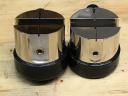
Modified TMF with brass inserts:
       

I flattened the mortise on my mill using a fly cutter, which pulled a little of the nickel plating off one corner.  This flattening took about 0.015" off of the length of the media groove, from the inlet media hole to the flattened area.  I am betting that does not significantly affect the tension/stretch. 

To further make getting the media under the clamping knob easier, I put a chamfer on the bottom corner, allowing the media to more freely slip under the knob with less backing of the screw. 
   

I am quite happy with these mods and feel I can secure the media faster, easier and it allows me to use shorter tag ends, which reduces media waste. 

Speaking of media waste, I didn't like how much media was left over after a test was run.  I wanted a modified TMF that could make use of those remnants.  So I made one, that has clamping screws on top of the TMF rather than on the sides.  I did this before learning that it mattered that the media was pulled over the sides and how long it is.  I don't really care, as when I use the remnants it will be for my own purposes and not for public information.  I've saved most of the remnants, having gone through one spool so far and well into the second.
   

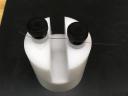
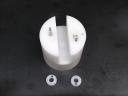
Here is the shop made TMF for holding remnant media (Remnant Media Fixture [RTM] Big Grin ).
       

Note there are washers under the locking knobs.  These are pinned in place so they do not rotate when the media is clamped, preventing the media from being wrapped around the screw but securing them as if in a vise. 

I have not made one additional mod of adding the pinned washer to the flat on the modified stock TMF, but it is a possibility.  I just don't feel the need for it.  

With all the discussion of how the media is mounted, wrapped and locked, I have always wrapped the media clockwise around the mortise side locking knob, reasoning that this possibly increases the tension and is part of the design and part the certification.  It is with curious amusement that I noticed in the Tutorial Video that was posted, that Mike wraps the media counter-clockwise (1:23 min. in the video).  This seems to me that it could loosen the media.  I mentioned this to Mike back in April when I was messing with all this.  I wonder hope it was done during the certification process.  

I am happy with the mods to the TMF and use it regularly.  The replacement TMF stands in reserve and will be used if there is ever a question about certifiable PT50 readings.  Since making the RTF, I have not really used it, although I have saved a nice supply of remnants, enough to do a nice statistical comparison.  

Rick

Reply
#27
Thanks for the pictures and detailed description of your modifications Rick. Both you and Grepper have provided some really useful ideas and we'll be attempting to incorporate some of these into our next manufacturing round which is on the fire right now. We're also going to take a swing at our version of Mark's cork insert with the knife fulcrum which seems to be a really good idea as well. Nothing can be more beneficial than listening to the people who use your products. Thanks to everyone for chipping in here!
Reply
#28
(05-31-2018, 05:27 PM)EOU Wrote: Thanks for the pictures and detailed description of your modifications Rick. Both you and Grepper have provided some really useful ideas and we'll be attempting to incorporate some of these into our next manufacturing round which is on the fire right now. We're also going to take a swing at our version of Mark's cork insert with the knife fulcrum which seems to be a really good idea as well. Nothing can be more beneficial than listening to the people who use your products. Thanks to everyone for chipping in here!

I am grateful to be perched on the shoulders of many giants.
Reply
#29
That's a very nice sentiment expressed there Ed and we feel the same as you do. We wouldn't be much without support and input from of our friends and customers.
Reply
#30
Well, as we said in an earlier post, we're listening. There may be a slight delay in travel time from our ears to our brains but, eventually, the message does arrive.  Pictured below are two pictures of the same prototype. We used one of our unplated ATF fixtures to test with.


As you can see we have cabbaged on to Greppers and Rick Kr's thoughts with regard to this fixture. The clamping design is composed of a knurled nut spinning on a 8/32 stud set on a 45° angle which corresponds with the 45° chamfer. This design offers many possibilities with regard to rerunning test media including leaving the fixture in place on the instrument while test media is rerun. In all cases it is much faster and requires less hand/finger dexterity. The machined relief and old screw hole mounting location will disappear in production units. Production units will be nickel plated.

Another plus is that because we have left what BESSU terms "Test Media Run Length" substantially unchanged, the design change already has preliminary BESS approval. We are making plans now for a new production run and anticipate that the new run will incorporate these changes.

Next project will be our version of Mark Reich's "cork in a fulcrum" idea.
Reply


Forum Jump:


Users browsing this thread: 1 Guest(s)