Posts: 592
Threads: 26
Joined: Mar 2017
Reputation:
0
Jan, don't worry about your english! You are light years ahead of me on secondary language skills.
I've actually never heard of atomic plane slip, but your diagram does help a lot!
I could be off base, but it looks/seems to me like it would take plastic deformation to make the atomic planes slip, since I assume atomic bonds are extremely strong, especially compared to the pressure of stropping.
Not trying to be a naysayer, Jan. Just seems like that would be something I'd be familiar with if it relates to sharpening.
I notice that the diagram is of "face centered" atomic structure, which means that is a martensitic diagram, right?
Posts: 504
Threads: 55
Joined: Feb 2017
I would like to second Mark's comment about English. On another sharpening forum, we have members from all over the globe. English is sometimes a native labguage, and sometimes a second or third language. English fluency varies. We have regional dialect differences as well. I think the linguistic differences make the forum more interesting, like seasoning on a meal.
I am much more interested in the knowledge being shared than in minor language missteps. The late photographer, Ansel Adams, once said, "There is nothing worse than a sharp picture of a fuzzy concept."
We have some bright, experienced sharpeners on this forum with good ideas to share. Let's not be concerned with minor details like language usage.
Ken
Posts: 361
Threads: 11
Joined: Mar 2017
(04-05-2017, 06:07 PM)Mark Reich Wrote: 1) Jan, don't worry about your english! You are light years ahead of me on secondary language skills.
2) I've actually never heard of atomic plane slip, but your diagram does help a lot!
3) I could be off base, but it looks/seems to me like it would take plastic deformation to make the atomic planes slip, since I assume atomic bonds are extremely strong, especially compared to the pressure of stropping.
Not trying to be a naysayer, Jan. Just seems like that would be something I'd be familiar with if it relates to sharpening.
4) I notice that the diagram is of "face centered" atomic structure, which means that is a martensitic diagram, right?
A d1) Mark and Ken, thank you for your tolerance to my English, it encourages me.  Ad2) Slippage means that planes of atoms slide by each other. It often occurs in cubic lattices with closely packed atomic planes. It has fundamental importance for material properties.
Ad3) Around 1900 material scientists discovered that steels undergo plastic deformation at much smaller forces then the theoretical steel strength. This mystery was resolved 50 years latter using electron microscopy which brought evidence that steel strength and ductility are controlled by dislocations.
Dislocations are areas within a grain where the iron atoms are out of their regular positions in the crystalline structure. Stress generates and moves dislocations. The movement of dislocations allows atoms to slip one another at quite low stress level. This slippage causes plastic deformation.
Ad2) Slippage means that planes of atoms slide by each other. It often occurs in cubic lattices with closely packed atomic planes. It has fundamental importance for material properties.
Ad3) Around 1900 material scientists discovered that steels undergo plastic deformation at much smaller forces then the theoretical steel strength. This mystery was resolved 50 years latter using electron microscopy which brought evidence that steel strength and ductility are controlled by dislocations.
Dislocations are areas within a grain where the iron atoms are out of their regular positions in the crystalline structure. Stress generates and moves dislocations. The movement of dislocations allows atoms to slip one another at quite low stress level. This slippage causes plastic deformation. 
 Ad4) Martensite in carbon steels is formed by rapid quenching of austenite form of iron. Austenite has the face-centered cubic lattice (FCC) while martensite has a body centred tetragonal basic unit (BCT).
Jan
Ad4) Martensite in carbon steels is formed by rapid quenching of austenite form of iron. Austenite has the face-centered cubic lattice (FCC) while martensite has a body centred tetragonal basic unit (BCT).
Jan
Posts: 948
Threads: 74
Joined: Mar 2017
Reputation:
0
04-06-2017, 01:08 PM
(This post was last modified: 04-06-2017, 01:11 PM by grepper.)
Mark sayeth, “All of these abrasives are available with different size grit particles, and this is where we get so many compounds. I have 80 micron CBN (200 grit)”
Mark, have you found that it’s actually possible to sharpen with compounds? My previous experience with compounds is that they are really only for polishing. That said, I have not tried any of the newer super saturated compounds. Which compounds carry CNB abrasives at near saturation levels?
Jan, I’m sure that you can understand my skepticism that rubbing hardened steel on leather could possibly alter the crystalline structure of the steel. I know you can bend an edge, but actually change the structure of the steel? I can understand smearing peanut butter on toast, but smearing steel on leather?  That said, I have totally no idea at all of what I’m talking about and more than willing to be surprised. I can’t see radiant heat or gravitational waves either but nonetheless I’m convinced of their existence.
Oh, yeah, Jan- You would be surprised at how many native English speaking people speak it much less fluently than you do!
Posts: 361
Threads: 11
Joined: Mar 2017
04-07-2017, 01:45 AM
(This post was last modified: 04-07-2017, 07:11 AM by Jan.)
(04-06-2017, 01:08 PM)grepper Wrote: Jan, I’m sure that you can understand my skepticism that rubbing hardened steel on leather could possibly alter the crystalline structure of the steel. I know you can bend an edge, but actually change the structure of the steel? I can understand smearing peanut butter on toast, but smearing steel on leather? That said, I have totally no idea at all of what I’m talking about and more than willing to be surprised. I can’t see radiant heat or gravitational waves either but nonetheless I’m convinced of their existence.
Grepper, on the one hand I understand well your skepticism, but on the other hand I expected that you, as an expert in burrs microscopy, might be willing to digest my innovative pilot hypothesis more easily.
Thank you for coining the term "smearing steel on leather". Please do not underestimate the traction (adhesive friction) of the leather wheel especially without honing compound. You surely know that gold and some other metals could be hammered by hand into sheets or drawn out into very fine wires. Gold leaf may be only several atoms thick and than it is almost transparent. You can easily smear or melt it between your fingers.

 All this is about malleability and ductility of materials and it is in intimate relationship with plastic deformation. Goldbeating is an example of cold-working because the plastic deformation occurs at a room temperature which is low and does not allow gold atoms to rearrange themselves.
Jan
Posts: 948
Threads: 74
Joined: Mar 2017
Reputation:
0
Isn't comparing the ductility/malleability of the element Au with steel alloy a bit of a stretch? 
Posts: 592
Threads: 26
Joined: Mar 2017
Reputation:
0
Jan, Thank you for correcting me on martensite atomic structure. I should have checked for myself. I took for granted we would be discussing martensite, but I knew something wasn't jiving. It's great to have your knowledge here!
Grepper, I have tried around 40 compounds, but I only use Ken Schwartz's because I've never seen anything better, and I know I can trust him. I've seen his lab's analysis of many compounds, and I can certainly see why many people are not having much success with compounds. The garbage that comes from China is pervasive. It doesn't cost much, but it doesn't work.
Ken's standard compounds are at least as good as anything I've ever seen, and yes, they work. Every time.
You get as many carats of grit per ounce of compound that you want. As you go to larger grit, you get fewer grit particles per carat, so I order double carats per ounce. That's mainly because I don't like to constantly apply compound.
I've pushed the envelope toward coarser grits because I don't like polished edges any more than you. It doesn't matter much what you use, if it's 1 micron, that's 16k grit. 16K is going to polish anything, but that's the most popular grit. It works great for straight razors, which is a huge chunk of the compound market, but most people don't make that connection either.
I've used 30 to 80u CBN to great success, especially on burr prone stainless steel. It's more effective to use a linen belt with 80u CBN than using 200 grit belts with AlO grit.
Keep in mind that I see far more cheap stainless knives than anything else. The most important thing is minimizing and eliminating burr. Boron Carbide (Black Diamond) is most effective at removing burr, but it leaves a very smooth edge, so after polishing the edge, I make a very light pass with 8u diamond.
It's probably not possible to describe everything perfectly. Hope this gives you a little better picture.
Posts: 948
Threads: 74
Joined: Mar 2017
Reputation:
0
04-07-2017, 10:29 PM
(This post was last modified: 04-07-2017, 10:40 PM by grepper.)
Mark, thanks for the input. Really appreciated.
If you are going with 80u compound, then why bother with compound at all? Why would that remove burr any better than, say, an open coat 180-220 grit belt? I mean, I would assume that the compound on linen would not be as solidly attached to the belt as a fixed abrasive, but the result, if the compound is actually cutting, would be similar only somewhat less.
I can, in theory, understand how the wrap around effect of a linen belt would help remove burr, but then why add compound? If the point is to remove burr and not to polish, why not just dry strop?
Posts: 361
Threads: 11
Joined: Mar 2017
04-08-2017, 03:35 AM
(This post was last modified: 04-08-2017, 01:04 PM by Jan.)
Mark, you are welcome.
Grepper, you are correct, gold is the most malleable of all metals, 1 gram can be beaten into a sheet of 1 m².
I have used this analogy to demonstrate that burr-related phenomena may belong in the nanoscale domain, which means that at least one dimension should be smaller than 50 nm. Referring to Mike’s searching the width of the apex of a standard DE razor blade is about 100 nm (0.1 micron). Based on this figure I am convinced that many segments of the hanging burr, which are not firmly attached to edge, should be considered as nanoscale objects.
 Matter behaves differently at nanoscale! Many parameters are significantly different from those of the bulk material. Hardness of metal can be several times larger when the grain size is reduced to nanoscale dimensions.
Nanoscale seems to be the key to so called "smart materials".
Jan
Posts: 361
Threads: 11
Joined: Mar 2017
04-08-2017, 06:25 AM
(This post was last modified: 04-08-2017, 10:17 AM by Jan.)
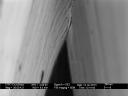
Some two years ago I have found on scienceofsharp wonderful SEM image (30.000 x mag.) showing a foil-like burr some 20 nm thick. The author claimed, that one lap on leather strop with 0.25 diamond spray was able to remove some 1 nm of the burr thickness’s. It was like a revelation for me. 
 Jan
Jan
|