


It is my pleasure to discuss with you things of our common interest, Mr. Mark. 
The wet-forging is originally Japanese technique to blow off scale from the steel surface by making small water steam explosions when a wet hammer hits a wet anvil face. In the past when coal was used for steel heating there was much more scale on the steel surface than nowadays.
It is used in metalworking industry to clean the surface before hot rolling sheet steel.
The book The Wonder of Knifemaking by Wayne Goddard briefly mentions wet-forging in the following paragraph:
![[Image: The%20Wonder%20of%20Knifemaking%20by%20%...I.jpg?dl=1]](https://www.dropbox.com/s/lwnjq8a5w4xjsv3/The%20Wonder%20of%20Knifemaking%20by%20%20Wayne%20Goddard_640DPI.jpg?dl=1)
The ratio 650 lb / 110 lb ≈ 6 corresponds just to the knee in the theoretical forging efficiency curve (some 85% efficiency). But as I mentioned above in my thinking the anvil base increases the effective anvil mass. So do not be afraid.
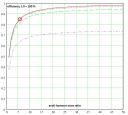 Calculated by Steve Alford, Sojourner forge, 2004.
The described anvil mounting on a pillar is good solution. We have used it for installation of seismometers to keep it good coupled to the basement while insulated from floor noise.
In my opinion for hand forging it is better to place the anvil on wooden log because its response is softer what is probably better for the joints on arms.
Jan
The wet-forging is originally Japanese technique to blow off scale from the steel surface by making small water steam explosions when a wet hammer hits a wet anvil face. In the past when coal was used for steel heating there was much more scale on the steel surface than nowadays.
It is used in metalworking industry to clean the surface before hot rolling sheet steel.
The book The Wonder of Knifemaking by Wayne Goddard briefly mentions wet-forging in the following paragraph:
(04-26-2017, 10:22 AM)Mark Reich Wrote: As for weight ratios for hammer and anvil, I can tell you my power hammer uses compressed air to drive a 110lb hammer onto a 650lb anvil. The thicker the concrete the hammer sits on, the better. Some go so far as to cut a 4' square out of the floor, dig 2' of dirt out, then fill the hole with concrete to mount the hammer to. This also isolates the jarring vibrations of the hammer blow, so you aren't vibrating your whole shop.
My slab is big and thick enough that I don't have much problem with that. The only exception being my knee mill. I'm going to bring it to town. I have enough space in one garage for my mill and a nice metal lathe with plenty of room for a car too.
The ratio 650 lb / 110 lb ≈ 6 corresponds just to the knee in the theoretical forging efficiency curve (some 85% efficiency). But as I mentioned above in my thinking the anvil base increases the effective anvil mass. So do not be afraid.
The described anvil mounting on a pillar is good solution. We have used it for installation of seismometers to keep it good coupled to the basement while insulated from floor noise.
In my opinion for hand forging it is better to place the anvil on wooden log because its response is softer what is probably better for the joints on arms.
Jan