


Mr. Brian, Mr. Grepper and Mr. Mike, this is an exciting and inspiring thread for me. I was so curious if the concept works that I made my own wooden model.
I used my 2 x 60" belt grinder and on the miter saw I cut a wooden block for 15⁰ bevel angle per side. To avoid the pull of the blade into the gap I lowered the rpm to 800. This is the minimum of my regulator and corresponds to some 15 Hz three phase current! This really solved the problem with the blade pulling I faced at 1600 rpm.
Until now I have tested it on two knives only and without any experience, but it worked quite fine. I have measured the sharpened bevel angle with my laser goniometer and to my surprise the laser reflection was not 15⁰ but in a band between 10 and 12⁰. My preliminary explanation is that the when the edge displaces the belt from its straight path it starts to wrap the edge which lowers the bevel angle. The grind is no more flat but convex (sabre).
Thanks again for all your posts.
Jan
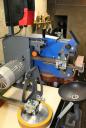
I used my 2 x 60" belt grinder and on the miter saw I cut a wooden block for 15⁰ bevel angle per side. To avoid the pull of the blade into the gap I lowered the rpm to 800. This is the minimum of my regulator and corresponds to some 15 Hz three phase current! This really solved the problem with the blade pulling I faced at 1600 rpm.
Until now I have tested it on two knives only and without any experience, but it worked quite fine. I have measured the sharpened bevel angle with my laser goniometer and to my surprise the laser reflection was not 15⁰ but in a band between 10 and 12⁰. My preliminary explanation is that the when the edge displaces the belt from its straight path it starts to wrap the edge which lowers the bevel angle. The grind is no more flat but convex (sabre).
Thanks again for all your posts.
Jan