


I’ll try to answer, or rather, express my opinion on some of the questions raised here. I’m not saying I’m right, but instead just sharing my own experience. Other folks may do things completely differently. Whatever works best for you is the way to go.
First, about the overheating thing with belt sharpening. This topic has been extensively discussed here and testing was done. In summary, for all intents and practical purposes it’s just not an issue.
http://bessex.com/forum/showthread.php?t...08#pid4008
Is it possible to overheat an edge even with the lower belt speed Kally? Absolutely it is! Just jam the blade hard into the belt and hold it there. Take a bolt and press it hard pinching the belt between the bolt head and the platen. It will get really hot very quickly. Is it possible to burn a piece of wood by jamming it as hard as you can into the blade of a table saw? Sure. Can you remove the skin on your face by jamming the razor against your face really hard and then pulling down? Yikes! It’s creepy to think about doing that.
The point is that any piece of equipment must be used correctly. Used correctly a saw will give a clean cut and a razor provides a clean smooth shave.
On the Kally, I sharpen 1” above the platen on the open belt and use very little pressure. So little pressure in fact that there is virtually no deflection of the belt. Sharpening is not knife making. For me at least sharpening works best with a very light touch.
Heavy pressure creates nasty big burrs and the dreaded pile of metal stuck to the edge dubbed here as Line of Weld (LOW) or what I think some folks call a wire edge. LOW is pesky and sans understanding of what it is, it can be difficult to remove. To remove more metal use a coarser abrasive rather than more pressure. Like I said before, for me at least sharpening is best with a very light touch.
http://bessex.com/forum/showthread.php?t...41#pid4341
For reference, a BESS 1,000 edge is 1 micron wide, so it’s important to keep in mind just how thin a BESS 100 edge is. The edge can be bent with hand pressure by just pressing it against a hard edge. Once the blade is sharp, anything other than light pressure is detrimental.
Mr. Bud said, “… I'd be interested in knowing if the faster belt speed might even be better for burr removal.”
I would think there is no advantage to a faster belt for deburring. Why? Well, from what I have seen burr is comprised of two parts; the base (LOW) that is stuck to the bevel, and flimsy junk on top of it. LOW can be removed by gently pushing against it with the tip of an Exacto blade. No speed there at all. Better yet is a light pass on a Scotch-Brite belt. Scotch-Brite or other conditioning belt of the same ilk almost magically grabs onto the LOW and lifts it from the edge. I was searching for a way to remove LOW and simply, by hand, dragged a blade across a Scotch-Brite lying on the bench. I was amazed how well it worked. That cushioned lumpy, bumpy surface of the belt grabbed on the LOW and lifted it from the bevel.
Once the LOW is lifted from the bevel then the whole burr is just flimsy crap stuck to the edge. I remove it by bending it back and forth using the leather belt. I’ll hold the blade at 45° to the belt and then just tickle the belt with edge to bend the flimsy crap. Then do the same at about 90°, flip the blade over and do the same. Bending the flimsy crap at a sharp angle fractures it off quickly. Then a pass or two at sharpening angle.
Some folks deburr by using finer and finer abrasives. That works, but it is time consuming. Moreover, and most importantly, I prefer a toothy edge and the fine abrasive method of burr removal produces a polished edge.
As soon as the burr touches the belt, it flips over to the other side of the blade. Once it flips over a faster belt accomplishes nothing.
Back to the Kally. Because of the type of knife guide I use, I run the Kally in a vertical position. I can’t see the burr as it forms, but for me it’s a non-issue. I just remove the blade and look at it. That only takes a couple of seconds, but, yeah, I can’t see the burr being created.
The Kally can be operated in any position. I suppose it could be mounted upside down from the ceiling. You know, it’s just a motor, pulley and belt.
Mr. Ken said, “There is a very promising knife jig in development for the Kallie. Perhaps the inventor (Grepper) might give us an update.”
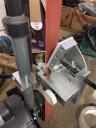
It’s almost done. I’ve just been dragging me feet on the final dregs of boring crap like writing an instruction manual, packaging and other details I totally hate dealing with. Here’s a picture of it.
Mr. blgentry. I hope this helps. Please remember that what I do and the equipment I use is just what works for me. I don’t like recommending equipment because what works for me may not fit your needs and/or methods. I am not recommending the Kally per se. It’s just what I use and what works well for me.
First, about the overheating thing with belt sharpening. This topic has been extensively discussed here and testing was done. In summary, for all intents and practical purposes it’s just not an issue.
http://bessex.com/forum/showthread.php?t...08#pid4008
Is it possible to overheat an edge even with the lower belt speed Kally? Absolutely it is! Just jam the blade hard into the belt and hold it there. Take a bolt and press it hard pinching the belt between the bolt head and the platen. It will get really hot very quickly. Is it possible to burn a piece of wood by jamming it as hard as you can into the blade of a table saw? Sure. Can you remove the skin on your face by jamming the razor against your face really hard and then pulling down? Yikes! It’s creepy to think about doing that.
The point is that any piece of equipment must be used correctly. Used correctly a saw will give a clean cut and a razor provides a clean smooth shave.
On the Kally, I sharpen 1” above the platen on the open belt and use very little pressure. So little pressure in fact that there is virtually no deflection of the belt. Sharpening is not knife making. For me at least sharpening works best with a very light touch.
Heavy pressure creates nasty big burrs and the dreaded pile of metal stuck to the edge dubbed here as Line of Weld (LOW) or what I think some folks call a wire edge. LOW is pesky and sans understanding of what it is, it can be difficult to remove. To remove more metal use a coarser abrasive rather than more pressure. Like I said before, for me at least sharpening is best with a very light touch.
http://bessex.com/forum/showthread.php?t...41#pid4341
For reference, a BESS 1,000 edge is 1 micron wide, so it’s important to keep in mind just how thin a BESS 100 edge is. The edge can be bent with hand pressure by just pressing it against a hard edge. Once the blade is sharp, anything other than light pressure is detrimental.
Mr. Bud said, “… I'd be interested in knowing if the faster belt speed might even be better for burr removal.”
I would think there is no advantage to a faster belt for deburring. Why? Well, from what I have seen burr is comprised of two parts; the base (LOW) that is stuck to the bevel, and flimsy junk on top of it. LOW can be removed by gently pushing against it with the tip of an Exacto blade. No speed there at all. Better yet is a light pass on a Scotch-Brite belt. Scotch-Brite or other conditioning belt of the same ilk almost magically grabs onto the LOW and lifts it from the edge. I was searching for a way to remove LOW and simply, by hand, dragged a blade across a Scotch-Brite lying on the bench. I was amazed how well it worked. That cushioned lumpy, bumpy surface of the belt grabbed on the LOW and lifted it from the bevel.
Once the LOW is lifted from the bevel then the whole burr is just flimsy crap stuck to the edge. I remove it by bending it back and forth using the leather belt. I’ll hold the blade at 45° to the belt and then just tickle the belt with edge to bend the flimsy crap. Then do the same at about 90°, flip the blade over and do the same. Bending the flimsy crap at a sharp angle fractures it off quickly. Then a pass or two at sharpening angle.
Some folks deburr by using finer and finer abrasives. That works, but it is time consuming. Moreover, and most importantly, I prefer a toothy edge and the fine abrasive method of burr removal produces a polished edge.
As soon as the burr touches the belt, it flips over to the other side of the blade. Once it flips over a faster belt accomplishes nothing.
Back to the Kally. Because of the type of knife guide I use, I run the Kally in a vertical position. I can’t see the burr as it forms, but for me it’s a non-issue. I just remove the blade and look at it. That only takes a couple of seconds, but, yeah, I can’t see the burr being created.
The Kally can be operated in any position. I suppose it could be mounted upside down from the ceiling. You know, it’s just a motor, pulley and belt.
Mr. Ken said, “There is a very promising knife jig in development for the Kallie. Perhaps the inventor (Grepper) might give us an update.”
It’s almost done. I’ve just been dragging me feet on the final dregs of boring crap like writing an instruction manual, packaging and other details I totally hate dealing with. Here’s a picture of it.
Mr. blgentry. I hope this helps. Please remember that what I do and the equipment I use is just what works for me. I don’t like recommending equipment because what works for me may not fit your needs and/or methods. I am not recommending the Kally per se. It’s just what I use and what works well for me.