


10-30-2018, 12:30 PM
Thank you much Jan for both your affirmation and your answers to our questions! We're only correct on the odd occasion so this is a grand day for us! 
We don't think that we're going to drill down to the answer on this definitely due to the fact that we agree that Tempilaq reaction time is a variable of unknown parameters and even other more advanced temperature sensing methods present questions as well. To that point, here's what W.B. Rowe http://citeseerx.ist.psu.edu/viewdoc/dow...1&type=pdf had to say on the matter;
"In practice, a thermocouple is incapable of responding quickly enough to reproduce the spike temperature accurately at the workpiece/ grain contact. The spike temperature is observed but attenuated. The thermocouple is, however, capable of responding to the background temperature without significant distortion. The duration of the background temperature pulse is measured in milliseconds which is sufficiently long to give rise to significant diffusion of heat to depths in excess of 0.1mm."
To the contrary, here's is what Babic/Torrance/Murray http://www.tara.tcd.ie/bitstream/handle/...sequence=1 had to say regarding the measurement of grind temperatures using a mofified thermocouple technology;
"The temperature of the cutting zone was accurately measured by the technique known as a single-pole thermocouple [13]. This technique has been accepted as the most reliable method available for measuring grinding temperature. One half of a standard thermocouple (in this case a constantan part) is separated from the other (the workpiece), insulated with two layers of mica, “sandwiched” between two halves of a split workpiece (Fig. 3). With the passage of the grinding wheel over the junction, constantan is smeared over the surrounding steel thus making a hot junction. In dry grinding, and with mist jets, the signal obtained is of high quality and due to the thermocouple's small size, its response is rapid making it possible to record the temperatures caused by individual grits (temperature spikes)."
Neither of these studies were attempting to determine how hot a knife blade gets while being ground with powered grinders. In one case the study involved alumina vs. CBN and the other studied water cooling vs. water and soap. Interestingly enough both of these sources produced temperature vs. grind depth graphs that, we think, might warm the heart of many belt grinding sharpeners. One, W.B. Rowe, speaks to dry grinding and the other, Babic et al, to wet. First the Rowe dry grind;
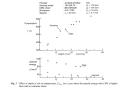
And the Babic;

Both studies indicate sub 200C (392F) temperatures when something on the order of only 5-8 microns of material is removed in a single pass. We'd think that 5-8 microns per pass would be regarded as a considerable amount of material removed when grinding (sharpening) a knife edge. These studies are detailed and we admit to only studying what seemed to be the pertinent parts. If anyone gleans something from them that we haven't, we would be pleased to learn what that might be.
We don't think that we're going to drill down to the answer on this definitely due to the fact that we agree that Tempilaq reaction time is a variable of unknown parameters and even other more advanced temperature sensing methods present questions as well. To that point, here's what W.B. Rowe http://citeseerx.ist.psu.edu/viewdoc/dow...1&type=pdf had to say on the matter;
"In practice, a thermocouple is incapable of responding quickly enough to reproduce the spike temperature accurately at the workpiece/ grain contact. The spike temperature is observed but attenuated. The thermocouple is, however, capable of responding to the background temperature without significant distortion. The duration of the background temperature pulse is measured in milliseconds which is sufficiently long to give rise to significant diffusion of heat to depths in excess of 0.1mm."
To the contrary, here's is what Babic/Torrance/Murray http://www.tara.tcd.ie/bitstream/handle/...sequence=1 had to say regarding the measurement of grind temperatures using a mofified thermocouple technology;
"The temperature of the cutting zone was accurately measured by the technique known as a single-pole thermocouple [13]. This technique has been accepted as the most reliable method available for measuring grinding temperature. One half of a standard thermocouple (in this case a constantan part) is separated from the other (the workpiece), insulated with two layers of mica, “sandwiched” between two halves of a split workpiece (Fig. 3). With the passage of the grinding wheel over the junction, constantan is smeared over the surrounding steel thus making a hot junction. In dry grinding, and with mist jets, the signal obtained is of high quality and due to the thermocouple's small size, its response is rapid making it possible to record the temperatures caused by individual grits (temperature spikes)."
Neither of these studies were attempting to determine how hot a knife blade gets while being ground with powered grinders. In one case the study involved alumina vs. CBN and the other studied water cooling vs. water and soap. Interestingly enough both of these sources produced temperature vs. grind depth graphs that, we think, might warm the heart of many belt grinding sharpeners. One, W.B. Rowe, speaks to dry grinding and the other, Babic et al, to wet. First the Rowe dry grind;
And the Babic;
Both studies indicate sub 200C (392F) temperatures when something on the order of only 5-8 microns of material is removed in a single pass. We'd think that 5-8 microns per pass would be regarded as a considerable amount of material removed when grinding (sharpening) a knife edge. These studies are detailed and we admit to only studying what seemed to be the pertinent parts. If anyone gleans something from them that we haven't, we would be pleased to learn what that might be.