


10-17-2018, 04:30 PM
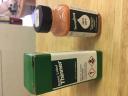
Well its Wednesday isn't it! Actually received our 325°F (163C) Tempilaq and thinner yesterday so we dove right into it this morning. Tempilaq is painted on to a surface in order to determine if that surface temperature reaches the trigger point, in this case 325°. 325° was chosen because that temperature represents the low end of the knife tempering spectrum.
The idea here was to attempt to judge if a belt grinder produces grinding temperatures at or above 325° while grinding a knife edge. Our approach here was, in the first stages of the test, to do those things that would lessen temperatures (minimal grinding duration and pressure) and then to increase both pressure and grind times in subsequent stages (assuming the Tempilaq wasn't triggered in the initial stage of the test). The belt grinder is a 1 x 42 Kalamazoo using a slightly used 150 grit Cubitron belt. No cooling means was used during the test other than the natural cooling that occurred between test segments. The knife is a cheap stainless santoku that had been sharpened previously to BESS 155. The bevel angle was approximately 19° and we maintained that angle with our Grepper designed knife rest.


We marked the test area on one side of the knife (the grind side) and then painted both sides with Tempilaq. Then allowed the Tempilaq to dry for 15 minutes. Here is what the grind side looked like prior to testing.

Trigger temperature attainment is indicated by turning Tempilaq from opaque pink to clear. Our first experiment was to only very lightly touch the knife edge on one side ("the grind side") and then inspect to see if the Tempilaq had been triggered on either the "grind side" or the "backside". Of course the abrasive belt would remove the Tempilaq from the grind area on the grind side but we still would be able to inspect immediately adjacent on both sides of the grind area for triggering and then the backside of the edge for same. Here's a micro pic of the center of the grind area after that first touch.

As expected the Tempilaq has been removed from the grind side bevel. You can clearly see opaque Tempilaq still sticking up from the backside however. Next we moved the scope to the side to look at the margins of the grind and still on the grind side. Then a micro pic on the backside of the edge.


We didn't get the nice clean delineation line that we expected between grind and adjacent Tempilaq. Its sort of a mixed bag but in any case, the Tempilaq is still opaque. The back side of the grind is still pure opaque Tempilaq.
With no sign of triggered Tempilaq we moved on but a little more aggressively. Since we weren't going to get a well defined line between Tempilaq and grind area we reverted to more standard grinding techniques by moving the blade slightly left and then back to the right thereby extending grind time and area. Then we took more micro pictures of the grind side and backside.


We've undoubtedly created a burr by now and it looks as if some of it has been pushed onto the backside but Tempilaq is still opaque. So now a third grind.


Now we are beginning to create serious burr visible on the grind side while the backside demonstrates nothing but opaque Tempilaq. It is becoming obvious now that we are in the process of converting our Santoku knife into a chisel ground edge. And a fourth grind.


Even bigger better bur but nothing but opaque Tempilaq to be seen. So is this stuff even working? We pulled out a heat gun to see. Of course you can see the Tempilaq disappearing right before your eyes when the heat gun is trained on the blade. Here's what it looks like, grind and backside, after the heat gun and under the microscope.


That's burr baby and one section of our santoku knife is now pure chisel grind! See how the Tempilaq has pooled and turned clear on the back side with just a few specs of opaque remaining? The grind side pic is even more dramatic to us in that the there is no longer any Tempilaq sticking up from the apex and backside. We guess the stuff is working, the test procedure described and the results reported. Now we can discuss what this all means.
The idea here was to attempt to judge if a belt grinder produces grinding temperatures at or above 325° while grinding a knife edge. Our approach here was, in the first stages of the test, to do those things that would lessen temperatures (minimal grinding duration and pressure) and then to increase both pressure and grind times in subsequent stages (assuming the Tempilaq wasn't triggered in the initial stage of the test). The belt grinder is a 1 x 42 Kalamazoo using a slightly used 150 grit Cubitron belt. No cooling means was used during the test other than the natural cooling that occurred between test segments. The knife is a cheap stainless santoku that had been sharpened previously to BESS 155. The bevel angle was approximately 19° and we maintained that angle with our Grepper designed knife rest.
We marked the test area on one side of the knife (the grind side) and then painted both sides with Tempilaq. Then allowed the Tempilaq to dry for 15 minutes. Here is what the grind side looked like prior to testing.
Trigger temperature attainment is indicated by turning Tempilaq from opaque pink to clear. Our first experiment was to only very lightly touch the knife edge on one side ("the grind side") and then inspect to see if the Tempilaq had been triggered on either the "grind side" or the "backside". Of course the abrasive belt would remove the Tempilaq from the grind area on the grind side but we still would be able to inspect immediately adjacent on both sides of the grind area for triggering and then the backside of the edge for same. Here's a micro pic of the center of the grind area after that first touch.
As expected the Tempilaq has been removed from the grind side bevel. You can clearly see opaque Tempilaq still sticking up from the backside however. Next we moved the scope to the side to look at the margins of the grind and still on the grind side. Then a micro pic on the backside of the edge.
We didn't get the nice clean delineation line that we expected between grind and adjacent Tempilaq. Its sort of a mixed bag but in any case, the Tempilaq is still opaque. The back side of the grind is still pure opaque Tempilaq.
With no sign of triggered Tempilaq we moved on but a little more aggressively. Since we weren't going to get a well defined line between Tempilaq and grind area we reverted to more standard grinding techniques by moving the blade slightly left and then back to the right thereby extending grind time and area. Then we took more micro pictures of the grind side and backside.
We've undoubtedly created a burr by now and it looks as if some of it has been pushed onto the backside but Tempilaq is still opaque. So now a third grind.
Now we are beginning to create serious burr visible on the grind side while the backside demonstrates nothing but opaque Tempilaq. It is becoming obvious now that we are in the process of converting our Santoku knife into a chisel ground edge. And a fourth grind.
Even bigger better bur but nothing but opaque Tempilaq to be seen. So is this stuff even working? We pulled out a heat gun to see. Of course you can see the Tempilaq disappearing right before your eyes when the heat gun is trained on the blade. Here's what it looks like, grind and backside, after the heat gun and under the microscope.
That's burr baby and one section of our santoku knife is now pure chisel grind! See how the Tempilaq has pooled and turned clear on the back side with just a few specs of opaque remaining? The grind side pic is even more dramatic to us in that the there is no longer any Tempilaq sticking up from the apex and backside. We guess the stuff is working, the test procedure described and the results reported. Now we can discuss what this all means.