


04-06-2018, 10:37 AM
Those are all very good suggestions Ken. I see no reason why the "Tommy Wheel" aka "Thomas Project" should not build upon the lessons learned by Tormek. I think that the ability to reverse direction is "baked into the cake" if we use traditional drive methodologies and not a lot different than the reversing scheme you describe in the one lunger engine with flywheel. I hope that our Thomas is not offended by the more familiar term used here for his name. If you are offended Thomas, just let me know. In my first job out of college (with Georgia Pacific) my sales manager's name was Gordon. All of our customers referred to him as "Gordo". I asked him if that bothered him. He told me that "I don't care what they call me just as long as they call me". While I'm on a roll here with names and the Georgia Pacific company, here's another one. We had a female accounts receivable clerk at our branch who went to an out-of-town bank and opened a checking account in the name of "Miss Georgia Pacific". Two weeks and 1.4 million later corporate figured out that something was wrong. By that time, she was gone and so was the money. That scheme probably wouldn't work today. Today, I have to swipe a bank card and show two forms of ID just to make a deposit in our corporate account. But I digress so back to business here.
Ken and I discussed via email this morning provision for deburring with the Tommy Wheel. I told him I had an idea and that I would send pictures. I decided that we just as well share with everyone. We have been experimenting with more efficient deburring methods and here is one that seems to work quite well. I think that this design could be incorporated into a sort of "flip out of the way", friction drive, device for the Tommy Wheel. We currently drive this prototype with either a fixed RPM gear motor or with just a drill motor if we want to test at different speeds.
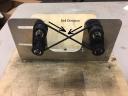
The "belt" is simply a high durometer .125" diameter "O" ring and is shaft driven from the backside. The pulleys are slightly offset so that the belt clears itself at the "V". We know that rubber works well for deburring from our Sharp Pad experience. In this design, up to three belts can be used at the same time.
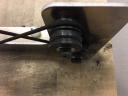
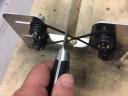
The concept is simple; pull the knife through and the burr is first pushed one direction and then back. Of course we get away from the flipping the knife over process that is so time consuming. If three belts are used this process is repeated three times with one knife motion. Using one belt, usually four or five pulls removes the burr. Does the edge cut the belt? No. The belt is always moving away from, not into, the edge. It will not remove those short, super gnarly burrs that have have been created by using too much grinding pressure. The burr in that case acts like a scraper and just starts to remove rubber from the belt. Any reasonable burr created by the sharpening process comes right off. Its an absolute dream for those super malleable burrs that Grepper has complained about.
The project pictured here can barely be called a prototype. It is more "proof of concept" in this state. As mentioned earlier, a friction driven version for the Tommy Wheel might just be the cat's meow.
Ken and I discussed via email this morning provision for deburring with the Tommy Wheel. I told him I had an idea and that I would send pictures. I decided that we just as well share with everyone. We have been experimenting with more efficient deburring methods and here is one that seems to work quite well. I think that this design could be incorporated into a sort of "flip out of the way", friction drive, device for the Tommy Wheel. We currently drive this prototype with either a fixed RPM gear motor or with just a drill motor if we want to test at different speeds.
The "belt" is simply a high durometer .125" diameter "O" ring and is shaft driven from the backside. The pulleys are slightly offset so that the belt clears itself at the "V". We know that rubber works well for deburring from our Sharp Pad experience. In this design, up to three belts can be used at the same time.
The concept is simple; pull the knife through and the burr is first pushed one direction and then back. Of course we get away from the flipping the knife over process that is so time consuming. If three belts are used this process is repeated three times with one knife motion. Using one belt, usually four or five pulls removes the burr. Does the edge cut the belt? No. The belt is always moving away from, not into, the edge. It will not remove those short, super gnarly burrs that have have been created by using too much grinding pressure. The burr in that case acts like a scraper and just starts to remove rubber from the belt. Any reasonable burr created by the sharpening process comes right off. Its an absolute dream for those super malleable burrs that Grepper has complained about.
The project pictured here can barely be called a prototype. It is more "proof of concept" in this state. As mentioned earlier, a friction driven version for the Tommy Wheel might just be the cat's meow.