


Well, ask and ye shall receive. Sometimes anyway. An industrial customer of ours happened across this Rockwell Study thread and sent us a link this morning to an outside forum thread. We read the thread and then copied the page and edited it so that the post could be displayed here minus extraneous material and links. The article is credited to a 2014 post by Mr. Tony Yan on Metallurgical Bladesmithing Forums. In our opinion it is extremely well written and if you'll follow this link http://www.hypefreeblades.com/forum/view...=694#p5656 you can read the post in its original form. If you read the thread in its entirety you'll see that our own Scott Livesey participated in the discussion. Here's the key - Mr. Yan asserts that the Vickers Hardness Scale is, essentially, linear. We have looked briefly and found, at least, one other article that supports Mr. Yan's assertion.
http://www.finetubes.co.uk/uploads/docs/...s_2014.pdf which says in part; " The Vickers hardness range is proportional, so a material of HV 400 is twice as hard as a material having a HV = 200"
This was news to us at EOU. So what does this mean for the question posed by this thread? Vickers to Rockwell C conversion charts are common. One need only to correlate any two Rockwell C readings with the corresponding Vickers readings and then to calculate the percentage difference between Vickers readings. You would then know how much harder one Rockwell C number is than another with some certainty. The accuracy of this calculation would be contingent on the precision of the conversion chart and the linearity of the Vickers Scale. We assume that various folks have produced a number of different conversion tables and that they might vary to some degree (just like grit conversion tables). Barring new information or arguments to the contrary, we may have, as close and as good an answer as we are ever going to get given the vagaries of the Rockwell C test method. Here is Mr. Yan's article with our edits;
First of all, I don't like the Mohs hardness scale, nor do I like the Rockwell hardness scale. Instead, I tend to prefer the Vickers hardness scale. Here are the reasons why:
Mohs hardness has almost zero engineering in it, so as you go up the Mohs scale, the jumps in hardness are almost random. For example, you may think, "Oh, with a Mohs hardness of 9, sapphire/ruby is almost as hard as diamond which has a Mohs hardness of 10." This is extremely misleading: diamond is actually four times harder than sapphire. In the Mohs scale, 10 is only 11% more than 9, but not 400% more. So why doesn't the Mohs scale have more entries between 9 and 10? Because there are very few rocks which are harder than sapphire yet softer than diamond. Mohs hardness was created for identifying rocks, and it is based on rocks which are common and somewhat consistent in hardness (ie: like quartz). (To see that diamond is "actually" 4x harder than sapphire, we'll consider Vickers hardness.)
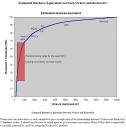
Next is Rockwell Hardness. What's "wrong" with Rockwell Hardness? Actually not too much. But Rockwell Hardness is non-linear. You might think that a Rockwell Hardness of 100 HRC is "twice as hard" as metal with 50 HRC. But this is simply not true. In fact, if you go through the definition of Rockwell Hardness, you will find that an infinitely hard material will have a Rockwell Hardness of 100 HRC. Not that HRC is used to measure anything above about 70 HRC. But you can see the non-linearity of Rockwell Hardness in the chart above. If you actually plotted the curve all the way to 100 HRC, the Vickers Hardness would go to infinity.
So why use Rockwell Hardness at all? Because, it is easy to measure. Relatively speaking, you can buy a Rockwell tester that is quick, cheap, and accurate enough for serious metallurgy. You can buy a Rockwell hardness tester for hundreds to thousands of dollars. Although the absolute accuracy of most HRC testers is only +/- 0.5 HRC, the relative accuracy is very good. This is because it is difficult to calibrate an HRC tester. When doing a measurement, you first calibrate the machine to the hardness of a "standard sample". But it turns out that a "standard sample" can only be manufactured to a tolerance of about +/- 0.5 HRC. So it's kind of like a weighing scale which is +/- 0.5 kg in absolute accuracy, but is much more accurate (say +/- 1 gram) for figuring out if something is heavier or lighter than something else. Those of you into metrology will recognize this as the technical difference between accuracy and precision.
At this point, you might wonder, "What is hardness anyways?" The short answer is, we don't know! In fact, there is no definition or understanding of what hardness is from first principles. So instead, we define hardness based on a procedure: put a specifically shaped diamond tip on the sample, and press it into the sample with a specific force for a given amount of time. Then measure how "big" the indentation is. All the various types of micro-hardness tests (like Rockwell, Vickers, Brinell, Knoop) are variations on this type of indentation test. They differ in the shape of the diamond tip, the force and duration applied, and how they measure "size" of the indentation. But if you were to ask a physicist what is the fundamental basis for these measurements, he couldn't tell you. And at this time we cannot figure out how to predict or even define "hardness" from the fundamental laws of the universe.
This should be contrasted with other quantities. For example, strength and toughness are defined in terms of fundamental physics. Strength is the force required to break a material, and toughness is the energy required to break a material. We do have fundamental definitions of force and energy, so in this sense we do have definitions which are based on first principles. The various types of strength (compressive, tensile, sheer, etc.) and toughness (Charpy impact, fracture, tensile, etc.) are based on different ways a material can break. We're just measuring either the force or the energy of breakage in different situations. For some discussion on strength and toughness, see the section called "Strength and Toughness of Materials" in an earlier post of mine:
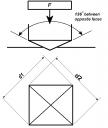
What is Vickers Hardness? The Vickers hardness test is very similar to Rockwell hardness, except for a few differences: First, the diamond indenter is a pyramid rather than a cone with a rounded nose. Next, the hardness score is not the depth of penetration. Instead, Vickers hardness is basically the force applied to the indenter divided by the area of indentation. Superficially, it has the same units as pressure (force / area), although the meaning is different. So if we had an infinitely hard material, then no indentation would form. Therefore, the area of the indentation is zero. Then the Vickers hardness would be the applied force divided by an infinitely small area (zero). This means that an infinitely hard material would have an infinite Vickers Hardness.
For details on Vickers Hardness, go look at Gordon England's website. Here is a diagram of the diamond indenter which is a square pyramid, and a diagram of the indentation it leaves.
So what's good about Vickers Hardness? First of all, it is "linear" in a technical sense. Infinitely hard materials will have infinite Vickers hardness. Furthermore, experiments show that Vickers Hardness is roughly proportional to the compressive strength of materials. That is, if you made a plot of compressive yield-strength versus Vickers Hardness, you would get a graph that was roughly a line. (See link above for discussion of strength.) Finally, Vickers Hardness is practical for measuring an incredibly wide variety of materials. Rockwell Hardness is only practical from about 20 HRC to 70 HRC. But Vickers is practical over a much wider range.
If Vickers Hardness is good, then why isn't it used more often? Well, Vickers Hardness is expensive and difficult to measure in practice. To find the area of the indentation, you need a high resolution microscope, and you need to optically measure the size of the indentation. Doing this accurately is actually a bit tricky. Compare this to Rockwell, where you just measure the depth the indenter penetrates; you can imagine this could be as simple as using a micrometer to measure how much the indenter has moved. Rockwell Hardness is simple enough that the machine can automatically measure the indenter's position. For Vickers Hardness, you can't just have the machine go and return a hardness value; instead you need to go through some procedure for measuring the area. Keep in mind that the area of the indentation is slightly complicated, because the material pushed aside will affect the area of the indentation pit.
Because it is more complicated to measure, Vickers Hardness is typically not used in manufacturing.
http://www.finetubes.co.uk/uploads/docs/...s_2014.pdf which says in part; " The Vickers hardness range is proportional, so a material of HV 400 is twice as hard as a material having a HV = 200"
This was news to us at EOU. So what does this mean for the question posed by this thread? Vickers to Rockwell C conversion charts are common. One need only to correlate any two Rockwell C readings with the corresponding Vickers readings and then to calculate the percentage difference between Vickers readings. You would then know how much harder one Rockwell C number is than another with some certainty. The accuracy of this calculation would be contingent on the precision of the conversion chart and the linearity of the Vickers Scale. We assume that various folks have produced a number of different conversion tables and that they might vary to some degree (just like grit conversion tables). Barring new information or arguments to the contrary, we may have, as close and as good an answer as we are ever going to get given the vagaries of the Rockwell C test method. Here is Mr. Yan's article with our edits;
First of all, I don't like the Mohs hardness scale, nor do I like the Rockwell hardness scale. Instead, I tend to prefer the Vickers hardness scale. Here are the reasons why:
Mohs hardness has almost zero engineering in it, so as you go up the Mohs scale, the jumps in hardness are almost random. For example, you may think, "Oh, with a Mohs hardness of 9, sapphire/ruby is almost as hard as diamond which has a Mohs hardness of 10." This is extremely misleading: diamond is actually four times harder than sapphire. In the Mohs scale, 10 is only 11% more than 9, but not 400% more. So why doesn't the Mohs scale have more entries between 9 and 10? Because there are very few rocks which are harder than sapphire yet softer than diamond. Mohs hardness was created for identifying rocks, and it is based on rocks which are common and somewhat consistent in hardness (ie: like quartz). (To see that diamond is "actually" 4x harder than sapphire, we'll consider Vickers hardness.)
Next is Rockwell Hardness. What's "wrong" with Rockwell Hardness? Actually not too much. But Rockwell Hardness is non-linear. You might think that a Rockwell Hardness of 100 HRC is "twice as hard" as metal with 50 HRC. But this is simply not true. In fact, if you go through the definition of Rockwell Hardness, you will find that an infinitely hard material will have a Rockwell Hardness of 100 HRC. Not that HRC is used to measure anything above about 70 HRC. But you can see the non-linearity of Rockwell Hardness in the chart above. If you actually plotted the curve all the way to 100 HRC, the Vickers Hardness would go to infinity.
So why use Rockwell Hardness at all? Because, it is easy to measure. Relatively speaking, you can buy a Rockwell tester that is quick, cheap, and accurate enough for serious metallurgy. You can buy a Rockwell hardness tester for hundreds to thousands of dollars. Although the absolute accuracy of most HRC testers is only +/- 0.5 HRC, the relative accuracy is very good. This is because it is difficult to calibrate an HRC tester. When doing a measurement, you first calibrate the machine to the hardness of a "standard sample". But it turns out that a "standard sample" can only be manufactured to a tolerance of about +/- 0.5 HRC. So it's kind of like a weighing scale which is +/- 0.5 kg in absolute accuracy, but is much more accurate (say +/- 1 gram) for figuring out if something is heavier or lighter than something else. Those of you into metrology will recognize this as the technical difference between accuracy and precision.
At this point, you might wonder, "What is hardness anyways?" The short answer is, we don't know! In fact, there is no definition or understanding of what hardness is from first principles. So instead, we define hardness based on a procedure: put a specifically shaped diamond tip on the sample, and press it into the sample with a specific force for a given amount of time. Then measure how "big" the indentation is. All the various types of micro-hardness tests (like Rockwell, Vickers, Brinell, Knoop) are variations on this type of indentation test. They differ in the shape of the diamond tip, the force and duration applied, and how they measure "size" of the indentation. But if you were to ask a physicist what is the fundamental basis for these measurements, he couldn't tell you. And at this time we cannot figure out how to predict or even define "hardness" from the fundamental laws of the universe.
This should be contrasted with other quantities. For example, strength and toughness are defined in terms of fundamental physics. Strength is the force required to break a material, and toughness is the energy required to break a material. We do have fundamental definitions of force and energy, so in this sense we do have definitions which are based on first principles. The various types of strength (compressive, tensile, sheer, etc.) and toughness (Charpy impact, fracture, tensile, etc.) are based on different ways a material can break. We're just measuring either the force or the energy of breakage in different situations. For some discussion on strength and toughness, see the section called "Strength and Toughness of Materials" in an earlier post of mine:
What is Vickers Hardness? The Vickers hardness test is very similar to Rockwell hardness, except for a few differences: First, the diamond indenter is a pyramid rather than a cone with a rounded nose. Next, the hardness score is not the depth of penetration. Instead, Vickers hardness is basically the force applied to the indenter divided by the area of indentation. Superficially, it has the same units as pressure (force / area), although the meaning is different. So if we had an infinitely hard material, then no indentation would form. Therefore, the area of the indentation is zero. Then the Vickers hardness would be the applied force divided by an infinitely small area (zero). This means that an infinitely hard material would have an infinite Vickers Hardness.
For details on Vickers Hardness, go look at Gordon England's website. Here is a diagram of the diamond indenter which is a square pyramid, and a diagram of the indentation it leaves.
So what's good about Vickers Hardness? First of all, it is "linear" in a technical sense. Infinitely hard materials will have infinite Vickers hardness. Furthermore, experiments show that Vickers Hardness is roughly proportional to the compressive strength of materials. That is, if you made a plot of compressive yield-strength versus Vickers Hardness, you would get a graph that was roughly a line. (See link above for discussion of strength.) Finally, Vickers Hardness is practical for measuring an incredibly wide variety of materials. Rockwell Hardness is only practical from about 20 HRC to 70 HRC. But Vickers is practical over a much wider range.
If Vickers Hardness is good, then why isn't it used more often? Well, Vickers Hardness is expensive and difficult to measure in practice. To find the area of the indentation, you need a high resolution microscope, and you need to optically measure the size of the indentation. Doing this accurately is actually a bit tricky. Compare this to Rockwell, where you just measure the depth the indenter penetrates; you can imagine this could be as simple as using a micrometer to measure how much the indenter has moved. Rockwell Hardness is simple enough that the machine can automatically measure the indenter's position. For Vickers Hardness, you can't just have the machine go and return a hardness value; instead you need to go through some procedure for measuring the area. Keep in mind that the area of the indentation is slightly complicated, because the material pushed aside will affect the area of the indentation pit.
Because it is more complicated to measure, Vickers Hardness is typically not used in manufacturing.