


It will be a year since Mike invited me to discuss hardness measurements. At first I did not want to participate because I thought it was a mature engineering discipline, as Mr. Mark wrote about it. But the challenging Mike's question "How much harder is HRC 61 than HRC 60?" made me to accept invitation to the discussion.
Hardness is the property of metal to resist permanent change of shape. Greater hardness means greater ability to resist to be permanently bent or broken when a load is applied. Hardness also means resistance to abrasion, scratching, wear, cutting or penetration.
The industry standard for knife steel is Hardness Rockwell Scale C often abbreviated as HRC and sometimes as Rc also. For steels HRC is related to tensile strength.


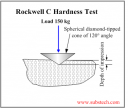
The HRC numbers are given by the depth of penetration of a small diamond-tipped cone of 120° included angle under certain load (150 kgf). Each HRC number represents 2 microns of indentation. When the penetration depth increases by 2 microns (≈0.000 08") than the HRC hardness decreases by 1 HRC number.
You tube video prepared by Materials Science 2000 provides explanation how the Rockwell hardness test is performed. https://youtu.be/G2JGNlIvNC4
The HRC number is calculated from the penetration depth h measured in mm as:
Rockwell Hardness HRC = 100 – h/0.002
The HRC numbers range from 0 to 100 HRC for diamond, but common knife steels hardness is form some 45 to 65 HRC.
To be continued until we find an answer to the question: "How much harder is HRC 61 than HRC 60?".
Hardness is the property of metal to resist permanent change of shape. Greater hardness means greater ability to resist to be permanently bent or broken when a load is applied. Hardness also means resistance to abrasion, scratching, wear, cutting or penetration.
The industry standard for knife steel is Hardness Rockwell Scale C often abbreviated as HRC and sometimes as Rc also. For steels HRC is related to tensile strength.
The HRC numbers are given by the depth of penetration of a small diamond-tipped cone of 120° included angle under certain load (150 kgf). Each HRC number represents 2 microns of indentation. When the penetration depth increases by 2 microns (≈0.000 08") than the HRC hardness decreases by 1 HRC number.
You tube video prepared by Materials Science 2000 provides explanation how the Rockwell hardness test is performed. https://youtu.be/G2JGNlIvNC4
The HRC number is calculated from the penetration depth h measured in mm as:
Rockwell Hardness HRC = 100 – h/0.002
The HRC numbers range from 0 to 100 HRC for diamond, but common knife steels hardness is form some 45 to 65 HRC.
To be continued until we find an answer to the question: "How much harder is HRC 61 than HRC 60?".