


12-07-2017, 12:05 PM
We've always said that we've learned far more from our customers than they have from us so we're back to the well here. This subject concerns one of our industrial customers who developed questions concerning sharpening protocols after purchasing one of our ID75A instrument systems. They provided us with samples of both new and used edges that are used in one of the their many cutting/slicing operations. The following picture was taken, by us, of one of their used blades. The blade is used in, what we would term, a planing operation. The blades are used to plane the surface of flat plastic bars. These blades are hardened tool steel, .125 inch thick and single bevel ground at 30 degrees. The customer refers to these blades as "skives". The following is an optical microscope image of the "flat" or backside of the blade.
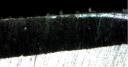
Not so pretty. We think that this edge has several problems but the question that we would like to pose here is this one; It would appear that the edge has rolled and that it has rolled toward the flat side of the blade (skive). This roll is bad enough that a fingernail can be hooked on it. Is this roll direction normal? From an apex structure standpoint it seems as if it might be but from an application standpoint (planing) it seems unlikely. Certainly this roll direction seems to be real deal killer in terms of a planing operation.
We're hoping that our woodworkers out there might be able to lend the benefit of their experience to this question.
Not so pretty. We think that this edge has several problems but the question that we would like to pose here is this one; It would appear that the edge has rolled and that it has rolled toward the flat side of the blade (skive). This roll is bad enough that a fingernail can be hooked on it. Is this roll direction normal? From an apex structure standpoint it seems as if it might be but from an application standpoint (planing) it seems unlikely. Certainly this roll direction seems to be real deal killer in terms of a planing operation.
We're hoping that our woodworkers out there might be able to lend the benefit of their experience to this question.