


05-29-2017, 12:13 PM
I have this cleaver, AKA kitchen axe that was one of a bunch of knives I purchased last week for $6.83 at the Salvation Army.
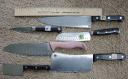
Labeled only “Basic Essentials”, "Stainless Steel" and “China”, I’m sure it’s blade is some nothing special steel.

The poor thing had been abused and abandoned to the Salvation Army by its previous owners. Yet another case of folks who’s solution for a dull blade is just to throw it away and buy a new one.
Other than seafood I eat no meat, and in my 60+ years of existence I’ve never used a cleaver and still have no use for one. However, I’ve seen them used in cooking shows on TV for dismembering and disassembling animal carcasses by placing the hapless carcass on a cutting board and whacking and hacking away. I saw another dude on a Mexican cooking show placing piles of pork flesh on a cutting board, and with a cleaver in each hand, rapidly chopping the meat into small pieces for manufacturing pork tacos. He was most efficient at the process, chopping large piles of flesh into tasty bite size pieces in only seconds.
The point is that obviously this blade is going to have to endure impacts, is used for push cutting and won’t benefit from a toothy edge. While there is some evidence that even with impact use a toothy edge may endure better than a smooth edge, I’ve always been under the impression that a cleaver should have a polished edge so that’s what I did.
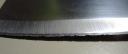
Its factory grind was at 20°, but this seemed too acute so I made it 25°. Probably should have done 30°, but oh well. I ground off the canyons and bashed in areas of the blade at 150 grit, then 240, 320, 400, 600, 800, 1000, 9 micron micro-finishing film belt, leather belt with Tormek 1-3 micron compound, and concluded with Mother’s Mag and Aluminum Polish on a soft felt belt. Of course, the result was a mirror finish bevel and a smooth, toothless edge.
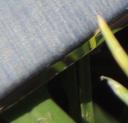
Microscopy of the thing is a really boring, uninteresting and yawn inducing smooth surface.

Upon completion the blade measured 235g sharpness at 3 locations, and one at 240g. Considering how it is to be used, I wouldn’t want it any sharper as the edge would be too thin to withstand impacts. Even 240g may be excessively sharp.
While pretty to look at, for general use it performs miserably. With the relatively fat bevel, smooth edge and only 240g sharp, it can barely cut through an orange. The blade edge just rides on the skin and requires a lot of force to break through. It can push cut 20# office paper, but fails on thin paper against the grain. It does OK on the thin skin of a pear.
For all intents and purposes it’s pretty much useless as a knife. But for whacking, hacking and bashing against a cutting board I suspect it would perform admirably. Too bad I have absolutely no use for the thing. But it was a fun little exercise, especially considering that I have a very low fun threshold.
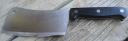
Labeled only “Basic Essentials”, "Stainless Steel" and “China”, I’m sure it’s blade is some nothing special steel.
The poor thing had been abused and abandoned to the Salvation Army by its previous owners. Yet another case of folks who’s solution for a dull blade is just to throw it away and buy a new one.
Other than seafood I eat no meat, and in my 60+ years of existence I’ve never used a cleaver and still have no use for one. However, I’ve seen them used in cooking shows on TV for dismembering and disassembling animal carcasses by placing the hapless carcass on a cutting board and whacking and hacking away. I saw another dude on a Mexican cooking show placing piles of pork flesh on a cutting board, and with a cleaver in each hand, rapidly chopping the meat into small pieces for manufacturing pork tacos. He was most efficient at the process, chopping large piles of flesh into tasty bite size pieces in only seconds.
The point is that obviously this blade is going to have to endure impacts, is used for push cutting and won’t benefit from a toothy edge. While there is some evidence that even with impact use a toothy edge may endure better than a smooth edge, I’ve always been under the impression that a cleaver should have a polished edge so that’s what I did.
Its factory grind was at 20°, but this seemed too acute so I made it 25°. Probably should have done 30°, but oh well. I ground off the canyons and bashed in areas of the blade at 150 grit, then 240, 320, 400, 600, 800, 1000, 9 micron micro-finishing film belt, leather belt with Tormek 1-3 micron compound, and concluded with Mother’s Mag and Aluminum Polish on a soft felt belt. Of course, the result was a mirror finish bevel and a smooth, toothless edge.
Microscopy of the thing is a really boring, uninteresting and yawn inducing smooth surface.
Upon completion the blade measured 235g sharpness at 3 locations, and one at 240g. Considering how it is to be used, I wouldn’t want it any sharper as the edge would be too thin to withstand impacts. Even 240g may be excessively sharp.
While pretty to look at, for general use it performs miserably. With the relatively fat bevel, smooth edge and only 240g sharp, it can barely cut through an orange. The blade edge just rides on the skin and requires a lot of force to break through. It can push cut 20# office paper, but fails on thin paper against the grain. It does OK on the thin skin of a pear.
For all intents and purposes it’s pretty much useless as a knife. But for whacking, hacking and bashing against a cutting board I suspect it would perform admirably. Too bad I have absolutely no use for the thing. But it was a fun little exercise, especially considering that I have a very low fun threshold.


