Posts: 361
Threads: 11
Joined: Mar 2017
04-26-2017, 02:57 AM
(This post was last modified: 04-26-2017, 05:12 AM by Jan.)
Mr.Mark, thanks for your anvil and hammer data. 
All anvil & hammer considerations I have read recommend for good forging efficiency that the anvil mass is as large as possible with respect the mass of the hammer. It is surely fulfilled for ratio 50:1, but already ratio 10:1 is sufficient to be above the knee of the efficiency dependence.
What is not well described in the efficiency considerations is the anvil placement. In my understanding an anvil mounted on a wooden log buried into the ground behaviours like a buoy on a dense viscous liquid. Under the hammer blow it penetrates slightly into the ground, changing its kinetic energy into work necessary to overcome the side friction from the ground. After reaching the maximum depth it elastically rebounds to the initial height above the ground.
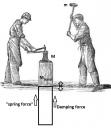
In my thinking the mass of the anvil's base increases the effective mass of the anvil which makes the above mentioned ratios very conservative.
So, your anvil/hammer mass ratio guarantees efficient forging, provided that the blade is sufficiently hot. If the blade is not sufficiently hot the hammer rebound is high and the forging efficiency drops no matter how massive the anvil is.
Posts: 361
Threads: 11
Joined: Mar 2017
04-26-2017, 05:30 AM
(This post was last modified: 04-26-2017, 05:34 AM by Jan.)
Mr. Mark, do you put your hammer in water before forging?
Is wet-forging mainly Japanese blacksmith's practice or is it used in US also? 
Posts: 592
Threads: 26
Joined: Mar 2017
Reputation:
0
04-26-2017, 10:22 AM
(This post was last modified: 04-26-2017, 11:16 AM by Mark Reich.)
You are Welcome, Mr. Jan. Thank You for this interesting discussion!
I would assume that mounting an anvil on a buried post is a great idea if you don't have a concrete floor. I would imagine you'd lose a lot of efficiency if the base was sitting on a dirt floor. You'd have a hard time keeping the base from walking around on it's own as well, but not on a buried post!
I've never heard of wet forging, and I'm pretty darn familiar with traditional Japanese bladesmithing.
I have no idea what could be gained from a wet hammer. I'm sure it's not to keep a hammer cool. That's not only unnecessary (hammers Never get hot), but somewhat counterproductive. Any extra heat loss from your work piece is just wasting the energy it took to heat the steel.
The only benefit of soaking a hammer head I can think of would be to tighten a loose fitting handle, but that doesn't make much sense either. There are much more effective ways of doing that.
Edited to add;
As for weight ratios for hammer and anvil, I can tell you my power hammer uses compressed air to drive a 110lb hammer onto a 650lb anvil. The thicker the concrete the hammer sits on, the better. Some go so far as to cut a 4' square out of the floor, dig 2' of dirt out, then fill the hole with concrete to mount the hammer to. This also isolates the jarring vibrations of the hammer blow, so you aren't vibrating your whole shop.
My slab is big and thick enough that I don't have much problem with that. The only exception being my knee mill. I'm going to bring it to town. I have enough space in one garage for my mill and a nice metal lathe with plenty of room for a car too.
Posts: 361
Threads: 11
Joined: Mar 2017
04-26-2017, 01:45 PM
(This post was last modified: 04-26-2017, 02:50 PM by Jan.)
It is my pleasure to discuss with you things of our common interest, Mr. Mark.
The wet-forging is originally Japanese technique to blow off scale from the steel surface by making small water steam explosions when a wet hammer hits a wet anvil face. In the past when coal was used for steel heating there was much more scale on the steel surface than nowadays.
It is used in metalworking industry to clean the surface before hot rolling sheet steel.
The book The Wonder of Knifemaking by Wayne Goddard briefly mentions wet-forging in the following paragraph:
![[Image: The%20Wonder%20of%20Knifemaking%20by%20%...I.jpg?dl=1]](https://www.dropbox.com/s/lwnjq8a5w4xjsv3/The%20Wonder%20of%20Knifemaking%20by%20%20Wayne%20Goddard_640DPI.jpg?dl=1)
(04-26-2017, 10:22 AM)Mark Reich Wrote: As for weight ratios for hammer and anvil, I can tell you my power hammer uses compressed air to drive a 110lb hammer onto a 650lb anvil. The thicker the concrete the hammer sits on, the better. Some go so far as to cut a 4' square out of the floor, dig 2' of dirt out, then fill the hole with concrete to mount the hammer to. This also isolates the jarring vibrations of the hammer blow, so you aren't vibrating your whole shop.
My slab is big and thick enough that I don't have much problem with that. The only exception being my knee mill. I'm going to bring it to town. I have enough space in one garage for my mill and a nice metal lathe with plenty of room for a car too.
The ratio 650 lb / 110 lb ≈ 6 corresponds just to the knee in the theoretical forging efficiency curve (some 85% efficiency). But as I mentioned above in my thinking the anvil base increases the effective anvil mass. So do not be afraid.
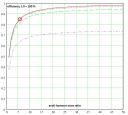 Calculated by Steve Alford, Sojourner forge, 2004.
The described anvil mounting on a pillar is good solution. We have used it for installation of seismometers to keep it good coupled to the basement while insulated from floor noise.
In my opinion for hand forging it is better to place the anvil on wooden log because its response is softer what is probably better for the joints on arms.
Calculated by Steve Alford, Sojourner forge, 2004.
The described anvil mounting on a pillar is good solution. We have used it for installation of seismometers to keep it good coupled to the basement while insulated from floor noise.
In my opinion for hand forging it is better to place the anvil on wooden log because its response is softer what is probably better for the joints on arms.
Jan
Posts: 592
Threads: 26
Joined: Mar 2017
Reputation:
0
Well Thank You, Mr. Jan. It's fun having someone with whom to discuss these matters of World Intrigue. 
I used my "Phone a Friend" card. I good friend of mine is a good friend of Mr. Wayne Goddard.
I have to say though, that sounds like an ill advised soundbite. It doesn't seem like he pursued it.
Caution; I have been very wrong before. 
Posts: 361
Threads: 11
Joined: Mar 2017
Mr. Mark, do not harden your mind prematurely, it has been written: "Do not quench the Spirit. …. but test everything; hold fast what is good." 
Jan
Posts: 592
Threads: 26
Joined: Mar 2017
Reputation:
0
Excellent quote, Mr. Jan. I certainly wouldn't prejudge anything you bring to the table.
I really like Mr. Wayne Goddard, and have tons of respect for him. One of my mentors, Mr. Ed Fowler, is one of the very few direct peers Mr. Goddard has left, IMHO.
I'm thinking that one wouldn't actually put the blade On the wet anvil, but holding the blade above the wet anvil as the blow is struck might be the answer. The blade would only come into direct contact instantaneously. I should have thought of that sooner. Guess I needed to sleep on it.
Posts: 361
Threads: 11
Joined: Mar 2017
04-28-2017, 10:02 AM
(This post was last modified: 04-28-2017, 10:03 AM by Jan.)
(04-27-2017, 11:30 AM)Mark Reich Wrote: I really like Mr. Wayne Goddard, and have tons of respect for him. One of my mentors, Mr. Ed Fowler, is one of the very few direct peers Mr. Goddard has left, IMHO.
Congrats, you have a famous mentor, Mr. Mark!
You may know if there are some laboratory hardness measurements of his 52100 Wootz blades available? I would be interested in a hardness profile running from the edge to the spine. Both, hardness and micro-hardness are important.
Posts: 592
Threads: 26
Joined: Mar 2017
Reputation:
0
Mr. Jan, "wootz" steel is somewhat of an enigma. I've always kept an eye out for information, but everything I've seen is pretty shaky. I don't know if anyone has really figured it out.
Professor Verhoeven *might* have figured something out. He surely tried, as have countless others, since wootz is said to be almost 2000 years old. If it was as superior as they say, basically every 'smith in the old world would have been trying to recreate it. Indeed, this goes on to this day.
I've heard a lot about it, but I don't know if anyone has truly figured it out. Many say they have, but I don't know of anyone who has undoubtedly created a superior blade, as wootz has been described.
To the best of my knowledge, wootz steel probably came from a unique iron ore deposit in some mid-eastern country that supplied the Persians, from where it's said to have originated. It's likely that this source was depleted by 1700 AD, and the process for creating it was lost to humanity.
Again, it's not that people haven't tried reproducing it, I just haven't heard of anyone making steel with the same banding as wootz, with the same superior performance characteristics.
Mr. Ed Fowler has always been a huge fan of wootz, and he's spent many decades trying to get wootz out of 52100. Sometimes he gets close to something that looks it, which is about what anyone else has done. He hasn't been able to beat the performance of regular 52100, but if you had 52100, 2000 years ago, I'm sure it would have been spectacularly high performance steel.
Posts: 361
Threads: 11
Joined: Mar 2017
Thanks for your interesting consideration, Mr. Mark, appreciated.
In the Bronze Age you would be a very rich man with your amount of 52100 steel. 
|