Posts: 948
Threads: 74
Joined: Mar 2017
Reputation:
0
That's what I keep thinking Mr. Jan. If there is any appreciable heating the heat/cool process is very ephemeral.
If there is indeed some Martensite conversion that would make the edge harder, correct?
I'm still of the thinking that, for all intents and practical purposes, this is mostly just intellectually entertainment rather than of any significant impact on edge performance. These edges are so thin they are going to roll regardless.
Posts: 361
Threads: 11
Joined: Mar 2017
(10-27-2018, 12:03 PM)grepper Wrote: If there is indeed some Martensite conversion that would make the edge harder, correct?
I think it depends on temperature and steel composition.
Jan
Posts: 948
Threads: 74
Joined: Mar 2017
Reputation:
0
Would you also say, Mr. Jan, that unless annealing temperature was reached it would be unlikely to soften the edge?
To me it seems far more likely that tempering temperature is far more likely than annealing temperature, and even so would be most minimal.
Posts: 361
Threads: 11
Joined: Mar 2017
Mr. Grepper, steel annealing is relatively slow diffusion process increasing ductility and decreasing hardness. In my understanding, during grinding, annealing does not occur, because the duration of the heating is too short. The fact that at some spots the temperature may be very high is not sufficient for annealing.
Steel of the blade after standard heat treating is in a metastable state, which is not stable and the desire of the steel is to move from this transient state towards a phase with lower inner energy. To accomplish this the steel needs some additional heat energy.
In my thinking the limited heat energy generated during grinding can cause some re-arrangement of iron atoms which form the martensite microstructure. Based on prof. Verhoeven the martensite was formed in milliseconds during quenching. It is easy to imagine that some iron atoms forming this martensite can adjusts their positions (occupied in a hurry) and so lower the inner energy. IMHO this quick atomic re-arrangement will cause some loss of blade hardness.
Jan
Posts: 500
Threads: 38
Joined: Mar 2017
We've been missing your input on this thread from the start Jan! Thank you for jumping in. With brutal honesty, and if we get your drift, we don't think that you put much stock in our Tempilaq experiment. If this is the case, please don't worry about us, we're attempting to learn something here, not propagate a false narrative with flawed experiments. We speculate that your objection might be based in that you don't think that the Tempilaq has sufficient time to react to the very short temperature spikes generated during the grinding process. We do not dispute the validity of this argument but, of course, this assumes that we have framed your thoughts correctly. It does raise a couple of questions though that we hope that you can help us with. (1) Martensitic formations are hard, not soft, aren't they? Please correct us if we've interpreted this incorrectly. (2) An element of Martensitic steel formation is rapid quenching (cooling). Do you feel that natural cooling in room temperature air may constitute "rapid quenching"?
Posts: 948
Threads: 74
Joined: Mar 2017
Reputation:
0
I have the same questions as EOU, but for me at least there are more reasons that basically mean for all intents and practical purposes any change in blade hardness from judicious sharpening is of little consequence. It’s intellectually and theoretically interesting, but not of significance for every day sharpening.
Maybe there is some hardening due to Martensitic formations, or maybe some softening due to having the metal torn apart. I doubt I’ll ever know for sure.
But there are two overwhelming points to consider:
From SET testing we have seen that for basic use knives there is little performance difference in edges HRC 52 – 62. They all roll. Even if the edge was softened slightly it’s probably still well within that hardness range. I have yet to see any evidence indicating that edges are actually annealed or changed to any significant degree.
Then there is the car being supported by an egg syndrome. Two eggs will be twice as strong but will still be reduced to a gooey disgusting mess by a car. Our very sharp edges are, by definition, extremely thin and weak. Regardless of hardness they are all going to roll and need sharpening. I have never seen a knife that does not get dull or one that with normal use stays sharp significantly longer than another.
I think this whole belt sharpening issue is interesting, but in the end, unless the blade is actually abused in the process, it really matters little how it’s sharpened. By hand, or by belt, by Tormek or by rubbing on a brick, they will all perform more or less the same.
Whatever method brings sharpening enjoyment, happiness and a satisfying edge is great. 
Posts: 361
Threads: 11
Joined: Mar 2017
(10-29-2018, 10:52 AM)EOU Wrote: We've been missing your input on this thread from the start Jan! Thank you for jumping in. With brutal honesty, and if we get your drift, we don't think that you put much stock in our Tempilaq experiment. If this is the case, please don't worry about us, we're attempting to learn something here, not propagate a false narrative with flawed experiments. We speculate that your objection might be based in that you don't think that the Tempilaq has sufficient time to react to the very short temperature spikes generated during the grinding process. We do not dispute the validity of this argument but, of course, this assumes that we have framed your thoughts correctly. It does raise a couple of questions though that we hope that you can help us with. (1) Martensitic formations are hard, not soft, aren't they? Please correct us if we've interpreted this incorrectly. (2) An element of Martensitic steel formation is rapid quenching (cooling). Do you feel that natural cooling in room temperature air may constitute "rapid quenching"?
EOU, you are correct!
Ad1) Martensite in steel is extremely hard and brittle, it is full of carbon and stuck dislocations.
Ad2) Martensite is formed during rapid quenching only. Cooling in air is not sufficiently rapid. In my cosiderations what may happen during blade overheating I have mentioned re-arrangement of some iron atoms in martensite only.
To better understand my thought processes please read the attached article by prof. Foell, German material scientist from Uni Kiel.
Jan
 MARTENSITE.pdf
 (Size: 200.63 KB / Downloads: 11)
Posts: 500
Threads: 38
Joined: Mar 2017
Thank you much Jan for both your affirmation and your answers to our questions! We're only correct on the odd occasion so this is a grand day for us!
We don't think that we're going to drill down to the answer on this definitely due to the fact that we agree that Tempilaq reaction time is a variable of unknown parameters and even other more advanced temperature sensing methods present questions as well. To that point, here's what W.B. Rowe http://citeseerx.ist.psu.edu/viewdoc/dow...1&type=pdf had to say on the matter;
"In practice, a thermocouple is incapable of responding quickly enough to reproduce the spike temperature accurately at the workpiece/ grain contact. The spike temperature is observed but attenuated. The thermocouple is, however, capable of responding to the background temperature without significant distortion. The duration of the background temperature pulse is measured in milliseconds which is sufficiently long to give rise to significant diffusion of heat to depths in excess of 0.1mm."
To the contrary, here's is what Babic/Torrance/Murray http://www.tara.tcd.ie/bitstream/handle/...sequence=1 had to say regarding the measurement of grind temperatures using a mofified thermocouple technology;
"The temperature of the cutting zone was accurately measured by the technique known as a single-pole thermocouple [13]. This technique has been accepted as the most reliable method available for measuring grinding temperature. One half of a standard thermocouple (in this case a constantan part) is separated from the other (the workpiece), insulated with two layers of mica, “sandwiched” between two halves of a split workpiece (Fig. 3). With the passage of the grinding wheel over the junction, constantan is smeared over the surrounding steel thus making a hot junction. In dry grinding, and with mist jets, the signal obtained is of high quality and due to the thermocouple's small size, its response is rapid making it possible to record the temperatures caused by individual grits (temperature spikes)."
Neither of these studies were attempting to determine how hot a knife blade gets while being ground with powered grinders. In one case the study involved alumina vs. CBN and the other studied water cooling vs. water and soap. Interestingly enough both of these sources produced temperature vs. grind depth graphs that, we think, might warm the heart of many belt grinding sharpeners. One, W.B. Rowe, speaks to dry grinding and the other, Babic et al, to wet. First the Rowe dry grind;
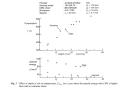 And the Babic;

Both studies indicate sub 200C (392F) temperatures when something on the order of only 5-8 microns of material is removed in a single pass. We'd think that 5-8 microns per pass would be regarded as a considerable amount of material removed when grinding (sharpening) a knife edge. These studies are detailed and we admit to only studying what seemed to be the pertinent parts. If anyone gleans something from them that we haven't, we would be pleased to learn what that might be.
Posts: 287
Threads: 34
Joined: Oct 2017
10-30-2018, 06:01 PM
(This post was last modified: 10-31-2018, 07:26 PM by KnifeGrinders.)
One has to interpret the grinding speed and the workpiece feed rate in their experiments to pulling the knife blade across the belt on his belt grinder, to ensure the sub 200C heating.
If I read their studies right, not to overheat the knife edge apex on a 7-8" wheel on a full speed grinder, one has to pull the blade at a feed rate of approx 10-20 cm per 1 second for 5-micron grind.
E.g. the blade feed rate not to overheat the edge on 10" paper wheels on a half-speed buffer is not the same as for your belt grinders.
For a given grinding/honing speed there is a certain safe feed rate, and if you pull the blade slower than that across your belt or wheel, the friction becomes detrimental.
http://knifeGrinders.com.au
Posts: 287
Threads: 34
Joined: Oct 2017
10-30-2018, 08:11 PM
(This post was last modified: 11-03-2018, 04:57 PM by KnifeGrinders.)
(10-29-2018, 11:16 PM)grepper Wrote: ...
From SET testing we have seen that for basic use knives there is little performance difference in edges HRC 52 – 62. They all roll. Even if the edge was softened slightly it’s probably still well within that hardness range.
...
I see a tendency to misinterpret SET-testing results, not personally Grepper, but I've heard opinions similar to what Grepper says many times and this conclusion simply can not be drawn from SET testing.
The BESS Set tester with a standard 150-gram steel roller at 10 degrees to the edge is good for testing the so called "working edge" sharpness, i.e. in the range of 300-500 BESS.
A single forward-backward SET roll moves the edge into this range, e.g. from 50 BESS to 250-300 BESS, and nothing like that ever happens in real cutting - the impact is too serious to obtain any meaningful data under 250 BESS, where the sharp and very sharp knives live.
Ceramic edges don't roll, but respond the same way - a single SET roll drops a 12 dps edge sharpness to 300 BESS, telling us that the impact is too much for the thin edge. I posted data on SET-testing of ceramic edges on this forum.
The standard BESS Set tester can not be used for testing edges sharper than 250 BESS, it is just not fit for that.
As I've mentioned several times by now, the difference imparted by common sharpening and honing methods matters in the initial performance of very sharp edges in the under 200 BESS range; these differences level out when the sharpness drops over 250 BESS.
When you think of sharpness as the edge apex width, it becomes pretty logical - subtle impact affects the thin edge. In fine honing, the effected area of the apex extends down to only 1.5 micron.
In applications where the sharp blade is a requirement, it all matters and matters a lot.
As you could see in our study Effect of Felt and Paper Wheel on Edge Retention, using a copper roller in the BESS Set tester allows to accurately test edges in the under 200 BESS range, but this is a separate story.
http://knifeGrinders.com.au
|