
Thread Rating:
  • 1 Vote(s) - 5 Average
  • 1
  • 2
  • 3
  • 4
  • 5
EDGE RETENTION/ROLLING PART II
#51
RESULTS:

We've finished most of our basic tests and are compiling the information. We thought it best to release the findings in pieces as opposed to one volume. Below you will find the results of one test.

If you recall, we did a quick and dirty test some weeks ago on two samples. One HRC50 edge and one HRC62 edge just to see if our pre-sharpen and post heat treat experiment had proved successful. The tests below use two different HRC50 and HRC62 samples than the ones  tested earlier. They did yield very similar results with the exception of one factor represented in the HRC50 samples. 

We don't recall discussing this previously but we did run a little side experiment here. As you recall, these are double edges samples and we treated each edge differently; while both sides (edges) were ground until a burr was present (pre heat treat), we performed preliminary burr removal on only one edge. This was just an experiment to see if a sharper edge resulted from pre burr removal as opposed to post heat treat burr removal. In some cases, this seems to made a lot of difference and others, minimal difference.

HRC50 blades seem to be the case that makes the most difference. Post burr removal edges in their case seem to result in much sharper edges. Here are the samples tested:
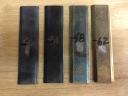
                                                        

The chart below represents (4) samples with two edges each. our #5,#7,#10,#12 and HRC50-62 respectively. The chart header contains the following legends PRE BURR (burr removed prior to heat treat), POST BURR (burr removed after heat treat) and final sharpness level achieved for each. Then POST SET (sharpness reading after edge rolling) and TOTAL ROLL (difference between initial sharpness and POST SET reading). Only the POST BURR edge was subjected to SET testing. The POST BURR sharpness level was used in calculating TOTAL ROLL. These test results report only the POST SET measurement after one SET cycle (5 times up and back).


We found it interesting that we were only able to achieve a sharpness level of 525 with the PRE BURR HRC50 sample. Not totally surprising though because we were only able to achieve 420 with the earlier HRC50 sample we reported. Note the difference between sharpness levels in the PRE BURR and POST BURR edges of the HRC50 sample though. While this trend continued in the balance of the samples it was not nearly as pronounced. All this has little to do with edge rolling but it is an interesting aside. 

Please keep in mind that these samples have not been sharpened post heat treat, only deburred with a plain leather surface. Post heat treat sharpening results are likely the next set of results that we will report. 



It is interesting here that results indicate harder steels seem to be less subject to roll by 10-20% than the softer samples. This reverses or, at the least, mitigates the trend that we had been seeing in production cutting edges. This is true with these results even though the edges began somewhat sharper. Our previous sharpened edge results have shown us that the sharper the edge, the greater the roll through Phase I tests (one cycle). Multiple cycle tests conducted by KnifeGrinders have seemed to mitigate this disadvantage. It is plain for us to see that burr removal is easier with the harder steels and results in somewhat sharper edges as well.
Reply
#52
Been waiting awhile for this so thank you for reducing my anxiety. In consideration of how much harder a Rockwell 62 knife is to sharpen and likely to chip than a Rockwell 58 I just don't see that it's worth it and that's even if the 20% holds up. I will withhold final judgement though until you divulge all test info. Maybe there is some benefit to carry knife users if the steel in them is more resistant to abrasion but even then I wonder. Rolling edges seems to be my problem with all edges of all sorts. This is good stuff and I appreciate your effort at eou. Thank you very much and looking forward to the rest.
Reply
#53
I agree Mr. Bud.  Mr. Max the Knife, who has sharpened a lot of real-world used knives, reported here some time ago that greater than 95% (I think he said something like 98%) of the well known high-end brand of => HRC 60 knives that he got in for sharpening were chipped.  

Most cutlery is in that HRC 54-58 range, and I suspect the reason is because commercial manufactures have learned over the years that is the sweet spot of price/performance and chip resistance.  So again, I agree with you Mr. Bud.  For me at least, 20% more roll resistance is not worth the extra cost and added propensity to chip with expensive harder steels, not even taking into consideration the increased difficulty when sharpening.  I would far rather have a dull blade to sharpen than an ever so slightly less dull chipped one.  That said, easier deburring is always welcome.

It’s also interesting to note that the difference between the total roll of HRC 54 and HRC 58 is only 8%.  For my use, 8% is statistically insignificant in real-world use.

It will indeed be interesting to see the sharpened after heat treating roll results as that is more real-world.  I’ve always wondered how deeply heat treating penetrates the blade.
Reply
#54
RESULTS SECTION TWO:

Still working with our 5,7,10, 12 we have sharpened them in the following manner:

These edges had a 19° micro bevel on them and we re-sharpened to 17°. So primary bevel = 15° and secondary = 17° in this set of samples. We used a 80 grit belt until we had raised a burr and then touched up with a 150 grit belt leaving a plenty toothy edge. We then removed the burr in exactly the same way for each sample. First we stropped on a thin HDPE plate, then on a rubber pad, then on a powered leather belt.

After taking our initial sharpness readings we ran all the edges through one cycle on the SET and then measured again. Here are the results:


This is about as tight a grouping as we have ever produced and would not expect results to remain this tight in future tests. One factor remains pretty consistent though through all of our tests to date; not a significant difference between lower and higher HRC hardness levels with regard to propensity for Phase I rolling.
Reply
#55
Typo on the HRC 50? Should Total Roll be 191?

Holy crap! It looks like sharpening is the great equalizer. The lack of deviation between HRC hardness roll resistance is amazing. Are you sure the old PT50A isn't stuck? Smile

This is not the first time SET testing showed commonly used in knives higher hardness steel is not really more roll resistant than commonly used less hard and less chip prone softer steel. Other than that, and some other apparently obvious conclusions, what else can we infer here?

Hardening is only skin deep?
The process of sharpening de-tempers the edge?

Or could it be that considering the thinness of an edge, and because it is so thin and structurally weak the hardness difference between HRC 50 and 62 is more or less irrelevant? Like you can't support a car on an uncooked egg. It will crush the egg. Two eggs would be twice as strong, but that difference would be irrelevant.
Reply
#56
EOU, thanks for posting the interesting results of the section two. It is good food for thought. Smile 

From a geometrical point of view the edge apex width of the initially sharpened blades was circa 0.4 microns.  The sharpness after the edge rolling (POST SET) dropped circa to the half of the initial sharpness. This may be interpreted as an increase of the "effective" edge apex width by almost 100%, to some 0.8 microns. In my understanding the edge rolling does not change significantly the edge apex width and so the "effective" edge apex width describes how the rolled edge interacts with the test medium.

The riddle is why there is not a more significant difference between lower and higher HRC levels of the tested blades.

Jan


Reply
#57
Thank you Grepper, the correction has been made to the chart. We think that your analogy of one egg versus two may just turn out to be correct in this case. Let's think about this a little differently though. What if you didn't place an automobile on the egg but rather a 1 LB. weight and that 1 LB. weight crushed the egg as well. Now place two eggs adjacent each other so that both bear the force of the 1 LB. weight equally. Let's say that, now, the two eggs, in tandem, support the 1 LB. weight without crushing. Now we have better established the parameters of the experiment and can begin playing with one egg and two egg combinations while more precisely varying the force impinging on them and, hence, come up with a fairly precise answer to the question "How much force is required to crush the average egg?" If we continue to use automobiles as our minimum force, however, we are not likely to discover the answer to the egg/force question with any precision.

We wonder if our 150 gram force applied to the edge is not, in effect, an automobile to a sharpened edge apex. We use a mass of 150 grams because it seems a very minimal and reasonable amount when compared to the forces that are applied to a knife edge in actual use and... it still seems reasonable. In fact though, perhaps if we were to use a 15 gram force, as opposed to 150 grams, then we might begin seeing significant differences  between various HRC hardness numbers. It's just food for thought and we have no intention of pursuing this experiment but it does make us wonder if we are trying to repair a swiss watch with a sledgehammer. Don't misunderstand Grepper, your point is well taken. If the real world dictates that it is eggs and automobiles then there is little point in experimenting with eggs and feathers.

Jan we believe that your understanding is the same as ours. The characteristics of the edge apex remain, substantially, unchanged through the rolling process. The roll itself presents a very substantial change in geometry, almost certainly several microns wide at dimension "A" in the following drawing.


 We know that a common knife cutting surface several microns wide would be a near useless implement so, whether cutting up pork loins, carrots or test media, the original edge apex must still be performing the work. This is something that we would like to understand better.

One other point here Jan. In a thread somewhere on the Exchange you expressed the possibility that "foil effect" might be the explanation behind the apparent ductility of sharpened edges. This was while we were advancing the possibility that the ductility of edges might be due to plasticized steel. We (EOU) have proven our theory invalid with these experiments so the only current viable theory left today is yours. Until such time as you are overthrown or abdicate, you are the King.
Reply
#58
Please define "foil effect".

How do these experiments invalidate the idea that plasticized steel is reason the edges are so ductile? I can understand how the pre-sharpened before hardening results might indicate plastic deformation is not in play, but I don't know if that logic applies to the blades that were sharpened after hardening.

I agree that it may be eggs-ackly correct and intuitively it makes sense to me that the edges are simply structurally weak because they are so thin and even 150gf causes loss of structural integrity. Ductility due to plastic deformation my actually be in play, but just irrelevant because the edge is structurally weak.

I sliced a potato that was sitting on a scale and it took something like 4-5 lb force to make the slice. And that was just a potato, not an acorn squash, carrot or anything else that would require even more pressure. The point being that in real world use we apply much greater force to our edges than a wimpy 150 g.
Reply
#59
EOU, thanks for the coronation, appreciated. Smile 

The "foil effect" in my understanding accents the fact that in very thin material the role of the surface increases and the difference between surface and bulk properties is significant. It is because the surface atoms are in an asymmetric environment.

The topic is for me quite complicated.  Even Wolfgang Pauli (Nobel Prize in Physics 1945) said: ‘‘God made the bulk; the surface was invented by the devil’’.

Jan


Reply
#60
You've got it right Grepper. We just weren't very clear in our message to Jan. These most recent tests have nothing to do with plasticized versus foil experiments. Our first tests several weeks ago did. When we found that our pre-sharpened and post heat treated edges rolled in a similar fashion to all other edges we concluded that plasticization of the edges during the sharpening process wasn't the source of the phenomena. Therefore, raise your glass to Jan and wish him a long and prosperous reign.
Reply


Forum Jump:


Users browsing this thread: 3 Guest(s)