Posts: 500
Threads: 38
Joined: Mar 2017
03-12-2018, 11:17 AM
(This post was last modified: 03-12-2018, 11:20 AM by EOU.)
It seems that discovery just breeds more questions. What's got us thinking this morning is this definition of hardness "Hardness may be defined as a material's resistance to plastic deformation." We found the first reference to this definition in a 1890's patent application for a means of testing hardness. A very cursory search makes it appear that this definition is well accepted today. Another definition that can be easily found is one that describes burr formation as "the result of plastic deformation". The metal that makes up the burr has, apparently, been transformed. We think that this explanation might answer an old question posed by Grepper in a thread entitled "Why are burrs so malleable?" We think the answer to that question might just be "because the steel that composes the burr has been transformed into a much more ductile form via plastic deformation."
We all know that when sharpening a knife that burr formation (plastic deformation) is the initial goal. So here is our first question; Is a HRC 62 edge more difficult to grind than a HRC 55 edge simply because it is offering more resistance to plastic deformation?
Here's the follow-up question that assumes you haven't developed serious disagreement with what we have proposed so far; Let's assume that we all would like to travel from point A to B. We elect to walk and you elect to ride your bicycle. We assume that you will arrive at point B before us and with less effort. But, in the end, we do all arrive at the same place. Could the same be said about edges whether they begin as HRC 62 or HRC 55?
Posts: 53
Threads: 1
Joined: Nov 2017
(03-12-2018, 11:17 AM)EOU Wrote: We all know that when sharpening a knife that burr formation (plastic deformation) is the initial goal. So here is our first question; Is a HRC 62 edge more difficult to grind than a HRC 55 edge simply because it is offering more resistance to plastic deformation?
Could the same be said about edges whether they begin as HRC 62 or HRC 55?
is higher hardness more difficult to grind is hard to answer. i always grind after hardening with wet belts at low speed. with the exception of a few Old Hickory knives, I usually grind blades that are Rc60-65. almost all of my knives are O1 or O7, low alloy high carbon steels, and usually considered easy to grind.
I don't use my knives hard enough to see a difference between the Old Hickory at Rc55 and the O7 at Rc64. I cook for 2 or 3 people, the O1 and O7 knives are 4" to 5" ajikiri style double bevel utility blades that I use most of the time. the blades are touched up every other month or so. the Old Hickory are larger butcher knives and see little use.
someone who sharpens for the restaurant industry could probably answer better.
scott
Posts: 947
Threads: 74
Joined: Mar 2017
Reputation:
0
Mr. Mike, I hate story problems. Answer: The HRC 55 train would arrive at the station 3:44 before the HRC 62 train.
It seems obvious to me at least and I assume that others have also noticed, that burr material is substantially different than the hard steel of the blade. I’ve seen burrs that can be bent back and forth many times acting more like gold than hard steel. Hardened steel is simply not that ductile. Hard steel chips and fractures while burr material acts like it has lost its hardness.
I’m not concerned here about how or why this happens, but simply noting that, for whatever reason, burrs act like very soft, ductile steel.
If this is true, I have two questions:
1. Is the burr material from RHC 62 steel any harder than a burr from RHC 56 steel or have both been equally softened during the sharpening process effectively equalizing both as far as hardness goes?
2. What implication does have for the very apex of the edge? How deeply into the blade does the softer metal go?
Would we deign to consider that the hardness of the apex of a hard steel blade is really equal to that of a softer steel blade, and that hard steel only occurs again significantly back from the apex?
Considering how soft and ductile burr material appears to be, it does beg the question.
Posts: 101
Threads: 2
Joined: Dec 2017
I find I cannot agree with some of the notions in this thread. First the overall goal is a sharp edge. Somewhere the idea was put forth a burr was a necessary step in reaching that overall goal. This has grown into a burr becoming a goal in and of itself. I have sharpened without forming a burr, but it is faster to form one and take it off in many cases. Think of it like this. One can make toast by heating the bread just right, or by using a torch and then scraping off the charred outer layer. It may well be faster with the torch.
Also, burrs are not universally floppy or ductile. Carefully formed burrs are quite rigid and I've had them scrape the compound off loaded strops and scuff up the smooth side of plain leather. This is why you'll often find me protesting the idea that strops are universally useful for removing burrs.
Posts: 101
Threads: 2
Joined: Dec 2017
Upon further reflection, I don't know of any mechanism aside from grinding heat that would soften steel during grinding. However, I have seen thin foil like burrs on edges ground on slow moving water cooled wheels. These types of burrs behave exactly like the ones Grepper describes. They flop around and behave very differently from the way we expect hardened steel to behave. However, when brittle materials get very thin, they begin to behave oddly. Even hardened steel has 2 to 3 percent ductility, and in foil like sections, this can be enough to explain their behavior.
Posts: 500
Threads: 38
Joined: Mar 2017
03-13-2018, 10:55 AM
(This post was last modified: 03-16-2018, 04:40 PM by Mike Brubacher.)
Well there you go. The stuff that discussion is made of. Couldn't agree more me2. There does seem to be burrs and then there are burrs. We've scratched up plenty of leather surfaces ourselves and we have also seen Grepper's gold foil. In one memorable occasion that we reported here on the Exchange, we generated both forms of burr and on the same knife on consequent sharpening events. Usually, the burrs we generate are rough, semi-gnarly sorts of things. Occasionally, the flimsy, foil variety. In either case, the burr can usually be bent from side to side of the edge and multiple times.
Our interest here is not so much how sharp an edge can be as how durable that edge is as in its resistance to both wear and rolling. We know that steels that most would regard as poor quality, can be made sharp. We get to see plenty of disposable 303, 304, & 316 stainless edges here and even those edges can be made sharp if one has the patience to hang in until the burr has been removed.
We began with the assumption that most people generate burrs when sharpening because that's what we think most people do. If we're in error with that assumption then we'd be happy to be set straight.
As we read it, steel that has suffered plastic deformation is not good stuff. While it is quite easy to find descriptions of plastic deformation it is not easy to find descriptions of the plastically deformed metal itself. We did find one though in a metallurgical sort of text book. Perhaps someone else could find other references.
"The consequences of real plastic deformation - Almost all properties of metals and
alloys change due to plastic deformation. The chemical and physical properties (
with the exception of some electrical characteristics) change to only a small
degree; however, the changes in the mechanical properties (including strength
and deformation characteristics) are significant."
Sorry for not crediting the author. It was bookmarked at home and we're all in the office at the time of this writing.The passage then went on to say that re-heat treating the deformed metal would restore it's former qualities. EDIT - Got it now - Physical Metallurgy for Engineers - Page 153 MIklos Tisza
Please take note in case there may be some misunderstanding: EOU has no position on this subject. As usual, we just have questions.
Posts: 101
Threads: 2
Joined: Dec 2017
Have you seen burrs that would scrape up the sharp pad? It wouldn't surprise me, as persistent as some of the more rigid burrs can be.
Posts: 500
Threads: 38
Joined: Mar 2017
Oh yeah - we mean, no! Sharp Pad is bullet proof of course me2. Well, yes. That's why Sharp Pad includes the HDPE plates. They absorb the brunt of the initial deburr process and a new burr will definitely put some grooves in the HDPE plates. Without HDPE plates your leather plate would end up looking like this:
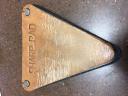
Actually most of that damage was done by setting sharp edges down just a little too quickly. Good stiff burrs would shred the smooth leather surface in short order. Bye the bye, if anyone is interested in a Sharp Pad you should let us know via EOU email because we will not be restocking Amazon (I think that there are only a couple left on Amazon as of this morning.) We're going to quit making them except for our own use. It's been a relatively successful product but we simply don't generate enough revenue with them relative to our edge tester sales now to make manufacturing and marketing them worthwhile.
Posts: 361
Threads: 11
Joined: Mar 2017
Sometimes ago I have read a paper concerning the behaviour of thin metal foils. They studied the behaviour of Al 99.5 foil, but I hope that some results may be applicable to steel burrs also.
The German author claimed, that the decisive parameter for occurrence of various so called scaling effects is the ratio of mean grain size to the foil thickness.
Jan
Posts: 500
Threads: 38
Joined: Mar 2017
We were hoping that you would take time away from your steel cooking projects long enough to weigh in here Jan! 
We're going to have to try to draw you in a little deeper though because we don't quite understand your meaning. We understand grain size and its relationship to strength calculations but don't know what "scaling effect" is relative to this discussion. Can you help us out? As that famous Tennessean thinker Jed Clampett would have put it, "cogitate on" this for us for just a bit please.
In another vein, we did discover, while researching Jed Clampett's historical roots, a possible negotiated settlement between the metric and standard measurement worlds. Here is the "Granny" system of measurement.
A smidgen is just a teeeenie, little bit…
3 smidgens make one pinch
4 pinches equals one little bit
4 little bits equal one midlin’ amount
3 midlin’ amounts equal one right smart and it takes 5 right smarts to make a whole heap.
As you can see the entire system is based on "just a teeeenie little bit" and everyone, no matter what part of the world you hail from, knows exactly how much that is.
|