Thread Rating:
  • 1 Vote(s) - 5 Average
  • 1
  • 2
  • 3
  • 4
  • 5
Edge Retention/Rolling Test Stand
#81
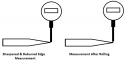
Sorry for the delay between posts but we haven't just been twiddling our thumbs. If you have been following here then you know that the way  we measure the extent of the roll on an edge is with an edge tester. The edge tester interprets the rolled edge as being dull. The duller the edge reading the greater extent of the roll. So what we have then is an interpretation of the roll, not a direct or physical measurement of the roll. We decided to take a shot at experimenting with direct measurements of the roll. We decided to do this for two reasons; (1) We really had no good idea about how far the roll extended laterally from the apex of the edge (we suspected in the .001" to .003" range). If we could answer this question more precisely then we could more accurately relate edge testing results to the physical dimensions of the roll and (2) It would give testers one more tool in analyzing and understanding the differences between steels and sharpening methodologies. One thing that we have always understood though is that the edge tester readings are where the rubber meets the road. It is fine to tell someone that an edge has rolled 42 microns but we know that the next question will always be "So fine, but how does that affect the cutting or slicing ability of my edge?".  That is the question that the edge tester answers most eloquently and precisely.  We used an adjustable test stand, a variance indicator capable of 1 micron accuracy and a specially constructed fixture designed to locate and relocate the knife in a repeatable fashion.  
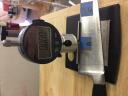
                                   

So the process was simple enough, measure the sharpened edge - zero the gauge - remove the knife from the stand and then roll the edge - place the knife back in the measuring fixture and measure the difference. Sounds simple enough but it didn't turn out that way for a couple of reasons. First, a 300 point roll i.e. begin 150 end 450 BESS produces a lateral protuberance that measures something under .001". 300 points of roll is a sizable roll and with only 25 microns in .001" that doesn't leave us with much scale or room for error. Second, repositioning the edge after rolling "accurately and repeatably" is a monumental and time consuming task. We were left with a much clearer idea of how small these rolls actually are but that's about it. 

We are currently producing 5 of our rolling test stands for distribution to our member testers. It looks as if the data is going to have to be gathered by their PT50A's B's and KN100's because it just doesn't look like a high-tech yardstick is going to get it.
#82
We're testing the new parts on our Structural Edge Tester and they seem to work just fine. These are the "raw parts" we pulled out of the batch prior to powder coating the ones we intend to send out to our volunteer testers. Here's what the current version looks like:


We decided to gather a little data while we were testing new parts so it was back to our Henkel Chef's knife and our standard 150 gram load. The Henkel was sharpened to 170 at the beginning of the test. If you recall the test is conducted by lowering a linear bearing onto the knife edge. The bearing is mounted at a fixed 10° angle so that we are assured of not damaging the edge apex and always inducing the edge to roll in a known direction. The bearing is rolled along the knife edge over a 1.5" long section of the edge. Forward and then back equals one cycle, 5 cycles equal one set. Our mission today? Determine how many sets it will require to roll the edge with 150 grams of force until it's maximum roll state has been achieved. Please keep in mind that we have been experimenting with sets/cycles in order to standardize the test. Earlier data has been reported using fewer sets/cycles. We think that 5 sets will now be our standard. We began with one set and the edge rolled from 170 to 390. Then:

(1) additional set - 440
(1) additional set - 490
(1) additional set - 522
(1) additional set - 565

Then we got in a hurry
(2) additional sets - 628
(4) additional sets - 647
(4) additional sets - 655

655 must be very close to the point where the edge stops rolling given the force used (150 grams). 655 represents 
a total roll of the edge of 655 - 170 = 485 points. 

Quite frankly the whole exercise seemed much like rolling dough except that instead of the dough getting thinner the edge just kept rolling until the depth of the roll and the force used, equalized. Some side notes here: at 440 only a slight glimmer of light was reflected back to our eye when looking at the rolled section of blade edge-on. Still though, quite noticeable. Could not hook a fingernail on the roll though at 440. At 655 the edge roll was very noticeable in reflected light and you could have hung your shirt on a wire hanger from the roll. We don't post many broadside perspective post roll pics and here's why, there's not much visible even with a 485 point roll.


You can get and idea of the roll extent though when looking at the rolled area "edge-on" versus the same perspective just an inch away where the edge was not rolled.


So where to next? Tomorrow we will be receiving a Shun VG10 HRC 60-61 knife for testing. The results of those tests will likely be for in-house use only because the results of high-end testing are supposed to be the province of our member testers. We will begin shipping out structural test stands next week to our testers.
#83
Sir

These numbers are absolutely fantastic!

I, can hear the "drum roll" of success, Yes!, brother just keep marching in the same direction.

Don't worry about rushing anything - the testers are all doing well in camp.


Rupert
#84
Happy to have you aboard Rupert! With you on our side we cannot fail.
#85
I think this is going to be big. Very big. Hope you talk about the Shun results as well when you have them. I looked up the Shun price and am dying to know if that knife tests three times better than the Henkel.
#86
A most perspicacious and sagacious observation Mr. Bud. While currently indeterminate, if indeed imperial data is supportive, I agree with your prognostication.
#87
(03-20-2018, 04:36 PM)EOU Wrote: ...standard 150 gram load
... The bearing is mounted at a fixed 10° angle so that we are assured of not damaging the edge apex....

I have two questions so far:
- will we will be able to decrease/increase the load, or your design is based on the number of rolls of the standard 150 g load;
- could you please confirm this works on edges ground at 10 degrees per side?
http://knifeGrinders.com.au
#88
Hello KG. The built in 10° angle of the bearing roller simply assures that the 150 gram force is applied with a lateral component. We want to assure ourselves that the edge is not being crushed but rather rolled. To date that design element seems to be doing its job. Having said that, we have only tested edges sharpened at 19°. The sharpening angle, in theory, shouldn't have a bearing on test procedure (as opposed to test results) though because the edge apex should always be orientated vertically no matter the sharpening angle. Here is an illustration that demonstrates the principle and a photo of the roller sitting on the edge:


See the black marks on the bearing surface? Those were made initially so that we could assure ourselves that the bearing was actually rolling and not just dragging across the edge. It rolls smoothly and doesn't drag so now we don't need marks.

We feel confident that this arrangement works well because when dealing with edges that have been rolled 200 points or so we are able to restore those edges to their original sharpness reading simply by stropping and straightening the edge on a solid surface. Of course this ability indicates to us that the edge apex was not damaged by the rolling process. Here's a better idea of how the test is conducted:


The roller is lowered at "A" then moved (rolled) over to "B" and then back to "A". Just like rolling out dough. That's one cycle. Five cycles equals a set. Five cycles (1 set) seems to even out inconsistencies and provides for a single, accurate, measurement of roll. Both pre and all post roll measurements are taken right in the middle of the rolled section. The force applied during roller movement (A-B-A) is kept constant because the roller assembly is attached to a piston shaft that can freely move up and down. This up and down freedom of movement automatically compensates for any small deviations in the height of the edge along it's 1.5 inch travel. Of course this is all powered by our favorite transmission source, gravity.

Now to your next question concerning "will we will be able to decrease/increase the load".  Yes, you will and simple provision has been made for that. If you refer to the picture of the device in our preceding post you will note the circular platen at the top of the force piston. Weight added to the platen will be directly transferred to the roller. Added weight would be what we would refer to as "advanced testing". Standard testing will consist of a 150 gram load with a roller angle of 10° and one set (five cycles) of movements. These parameters will keep all tests on a "apples for apples" basis. If someone wants to experiment using other parameters then feel free but one needs to keep in mind that these changes need to be referenced if reporting results publicly. 

Just a little bit more on your first question KG concerning the 10° angle. This angle is actually adjustable from 0 to 30° or so. This change would fall under "advanced testing" as well.

While we're feeling expansive here one last thought. After our failed experiment with attempting to take physical measurements of the roll with a micrometer set up then "thank our lucky stars for edge testers" or this facet of edge retention testing simply wouldn't be feasible in any practical way.  We always knew that edge testing would be more valuable information than physical measurements because once you tell someone that one edge rolled 5 microns versus another edge that rolled 9 microns they're going to look at you and ask "so what?". In other words, how does this information translate into how well my edge cuts? An edge tester will tell them precisely how that information translates. That being said, it would still be nice to have a physical measurement of the roll as just one more piece of information to work with. It's just not going to be in the cards. At least not for now.
#89
"A most perspicacious and sagacious observation Mr. Bud. While currently indeterminate, if indeed imperial data is supportive, I agree with your prognostication."

Mr. Grepper. Please compose your posts in English! If Bud is like us, he doesn't know whether he's supposed to send you flowers or challenge you to to a dual. Wink Bud we'll test the knife and then decide. We simply don't want to get out front of our member testers.
#90
We decided to get in one more test before we test the Shun tomorrow and we decided to go to the opposite side of the world to do it. We sheared off a couple pieces of 18 gauge cold rolled steel blanks in a manageable size (2" x 6").


To the best of our information this material is about B50 (not C, B) on the Rockwell. 18 gauge is about .050" thick. We ground a bevel at 19° using 80 grit ceramic and then finished it with 180 grit ceramic. Removing the burr was a nightmare and really not quite certain if we ever did get it all. (After looking at the picture below more closely, I'm pretty certain we didn't). We gave up when we got an edge that measured 275. 


Then we placed it in our Structural Edge Tester and ran 1 set then measured again. So pre roll we were 275 and post roll  818. That's 543 points of roll after only one set. We also began the test 100 points duller than we normally test at so the actual roll rate when compared to our other knives might have been even higher than 543. It was bad and that's close enough for the time being.

So why do we conduct such extreme if not ridiculous tests? To figure out where the fences are. We know something about the bottom of the barrel now and tomorrow we'll know something about, what Shun thinks anyway, is near the top.


Forum Jump:


Users browsing this thread: 3 Guest(s)