Posts: 361
Threads: 11
Joined: Mar 2017
02-16-2018, 06:42 AM
(This post was last modified: 02-16-2018, 06:45 AM by Jan.)
Mr. Me2, the interrelationship between HRC values and tensile strength is in reality quite complicated. It is often approximated by a third degree polynomial. Steel composition and heat treatment also influence relationship between hardness numbers and tensile strength. It was not our intention to analyse it in this study.
Jan
Posts: 101
Threads: 2
Joined: Dec 2017
Quite right. It's fairly complicated and an approximation only, as I've seen higher hardness correlate to lower strength when tests were performed. It is interesting that your findings appear to agree with with the strength approximations within those limitations. In other words, your research has found similar results to other, independent research on similar topics.
Posts: 361
Threads: 11
Joined: Mar 2017
02-16-2018, 09:13 AM
(This post was last modified: 02-16-2018, 09:25 AM by Jan.)
One important outcome of our linearity study is extremely simple formula which describes the non-linearity of the Rockwell hardness scale for a wide range of HRC numbers.
The curve in the graph showing the
percentage
increase
of
hardness (PIOH) between two following hardness numbers can be described by simple formula
PIOF (percentage increase of hardness)
= 200 / (100 – HRC)
Question: What is the percentage increase of Rockwell hardness for a blade 60 HRC?
Answer: PIOF (percentage increase of hardness) = 200 / (100 – 60) = 5 %
![[Image: Percentage%20change%20of%20hardness.jpg?dl=1]](https://www.dropbox.com/s/9y2nggknbxzb7tr/Percentage%20change%20of%20hardness.jpg?dl=1)
We have not found this formula in the huge amount of recherchéd papers and so we hope we were the first who derived it. The range of our formula outperforms known hardness conversion calculators.
 Jan
Jan
Posts: 500
Threads: 38
Joined: Mar 2017
Thank you for your comments, calculations and observations here me2. They are much valued and Mark R., the same goes for you. Your comment Mark, "Well, I'm not surprised I was wrong. I can do that all the time" is the only thing that you've written in this thread that is wrong. For us, knowledge takes two forms, things we don't know and things we think we know. When we began this thread we didn't know the practical relationship between Rockwell 60 and 61. Now we think we do with some degree of accuracy. Actually, some of your observations have helped lead us to where we stand today. Its a team effort on the BESS Exchange.
I (not "we") attended a scientific seminar some time ago and the speaker began his remarks with this statement "The sun always rises in the East, that is, up till now." I've always remembered that statement because it highlights the fragility of "what we think we know". Until the sun rises in the West one morning, we'll think that it always rises in the East.
You are very much far from alone, Mark, in your perception that steels exhibit much greater differential resistance to abrasion (and other qualities and characteristics as well we assume) than is indicated by our calculations. From that then is spawned another question, "what might be the other characteristics of various steel and/or the processes that steel undergoes in the knife making progression that would leave us with this impression?" In other words, "if its not hardness alone then what is it?" Perhaps food for thought in a another thread.
We simply cannot heap enough kudo's on our partner Jan's doorstep. We've been working together on this for the better part of a year and the answer popped out, literally, over the course of the past few days. Jan is the one who has packaged this up into a very neat, tidy, mathematical formula. Thank you Jan! We're going to have to get our heads together with Jan in order to decide how this should all be bound up into a complete reference material. We're sure that there will be more to come.
Posts: 101
Threads: 2
Joined: Dec 2017
I have held the view that hardness is a symptom, not a cause. Microstructure is what you're after. Two microstructures can have the same hardness, but behave differently in use.
Posts: 361
Threads: 11
Joined: Mar 2017
02-17-2018, 05:26 AM
(This post was last modified: 02-17-2018, 10:12 AM by Jan.)
Mr. Mike, it was my pleasure to collaborate with you in this study, which was initiated by your vision that it should be possible to answer the question about hardness change.
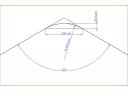
In this study we assumed conical indenter. In the future we can consider the fully realistic scenario with spheroconical shaped diamond indenter. This means that the conical diamond indenter with 120° included angle is blending with a spherical tip of 200 microns radius.

Jan
Posts: 500
Threads: 38
Joined: Mar 2017
As promised in our initial post we're going to now present our calculations concerning Rockwell C cone surface area increase/decrease as it relates to indenter depth of penetration. The following chart represents a collaborative effort including EOU personnel, Jan and one son-in-law who was drafted to craft the spreadsheet during his Thanksgiving holiday visit.
We look forward Jan, to refining this work.

Posts: 361
Threads: 11
Joined: Mar 2017
02-23-2018, 06:13 AM
(This post was last modified: 02-23-2018, 06:15 AM by Jan.)
Mike, thank you and your programmer for preparing the HRC Percentage Increase/Decrease of Hardness Calculator.
Knife manufacturers often specify blade hardness by lower and upper HRC limit. Thanks to the calculator we now know that for a blade with HRC 53-55 the percentage hardness increase is 8.7% while for a blade with HRC 61-63 it is even 10.5
Jan
Posts: 219
Threads: 36
Joined: Mar 2017
Reputation:
0
02-23-2018, 10:31 AM
(This post was last modified: 02-23-2018, 06:09 PM by Mike Brubacher.)
And thank you Jan for reducing the solution to a very elegant and succinct equation. This enabled us to construct a very simple and portable calculator. Now allow me to define "us" a little better. In this case "us" included one of our member knife makers and BESSEX contributors, Wade Bevan. Wade is a genius in the HTML/Java/Internet sort of code world. Not only did he put the calculator program together for us but he figured out how to make it display and function inside a BESS Exchange thread. No small task I can assure you and "thank you" to Wade. As we suggested to Mark R. in an earlier post, it truly is a team effort on the BESS Exchange.
I would add a couple of value statements to Jan's in his previous post. There are lots of folks in various industries and realms that are faced with decisions concerning the hardness of parts. That's why hardness testing exists. If they are given a "handle" on just what relative Rockwell C numbers mean they can make more informed decisions when considering changes or creating designs. In the knife world the same is true as it applies to at least one consideration, hardness. Now one can more accurately balance expectations of performance with reality.
I added a notation on the calculator page that indicates changes and expansions are coming to that page and they are. One of the things that we're going to do is give you the ability to download the calculator to your personal computer so that you can have ready access. In the meantime, please calculate on the BESS Exchange!
Posts: 1
Threads: 0
Joined: Mar 2017
This is too cool.
Thanks for putting in the work.