Thread Rating:
  • 1 Vote(s) - 5 Average
  • 1
  • 2
  • 3
  • 4
  • 5
Edge Retention/Rolling Test Stand
#51
I think I'd go with something that would remain unaffected by testing, like a solid carbide mill bit, as has been suggested. 

Seems like that would eliminate having to be dead center in a groove, which might roll the edge one way or the other.

Inexpensive and probably would remain unaffected forever.

I'm not a test device engineer though.  Wink
#52
New territory for us as well Mark. As a good Kansas friend of mine used to say "We're lost but we're making good time". We vacillate between a impactor that won't damage the edge and one that the edge won't damage the impactor. Just putting the new design together as we speak and will put a picture up soon.
#53
IMHO, you are a Super Genius on par with the master Wile E. Coyote, so maybe locate your ACME catalog and find something hard on one side, and soft on the other....

Or maybe have a common size hole that would hold a cylinder of carbide or hardwood dowel, say maybe 1/4" or 3/8" in diameter. I imagine we could find other cylindrical material, like aluminum or hard plastic to fit the same size hole. Perhaps.
#54
   

Here's what it looks like Boys.

   
#55
   
#56
First effort with the new impactor design. Well it works. It works a little too well but that will be easily adjusted. Same knife but different edge location. Initial sharpness was 150. Here's the test setup at the conclusion of the rolling exercise.


The new impactor piston assembly weighs 250 grams and the additional weight in the cup is 1750 grams for a total of 2000 grams (4.4 lbs). If you recall, in our earlier test with the 5/16" rod end this amount of weight didn't affect the edge. With only the radius of the 1" diameter rod contacting the edge now, it did and substantially so.


The good news is that when you roll them this severely you can see the damage at 140X. We think that you should be able to identify the section of rolled edge. You can also see that we missed the impact point when we placed the impactor on the edge. The picture here is representative of about 1/16" of blade so we missed by about half that distance or 1/32". We need to get better at placement. Once located, there was no difficulty in taking fairly repeatable measurements in consideration of the damaged edge. 694 - 732 -712. We very much suspected that this was too much of a good thing and we were proven correct. We could only correct the edge by leather stropping back to around 325. We think that this failure (to fully correct the roll) must be caused by one, or in combination with, two things; either we have damaged (crushed) the edge apex or the roll is so deep that a piece of leather can't straighten it. As we said earlier in this thread, our experience tells us that a differential of around 300 is about the limit. If you're interested, the measurement adjacent to either side of the impact point was 148 and 153. 

Next stop...1000 grams.
#57
Wow!  That's quite an impact on the edge for just gently lowering weight onto it.  I'm a bit surprised and thought that something like that would require impact of some sort to cause that amount of deformation of the edge.  I would say that data is indicative that you are on the right track.

If that test apparatus was sitting around my shop for very long I'd no doubt knock over that container of shot. Doh! 5arg
#58
(01-27-2018, 03:46 PM)EOU Wrote: First effort with the new impactor design. Well it works. It works a little too well but that will be easily adjusted. Same knife but different edge location. Initial sharpness was 150. Here's the test setup at the conclusion of the rolling exercise.


The new impactor piston assembly weighs 250 grams and the additional weight in the cup is 1750 grams for a total of 2000 grams (4.4 lbs). If you recall, in our earlier test with the 5/16" rod end this amount of weight didn't affect the edge. With only the radius of the 1" diameter rod contacting the edge now, it did and substantially so.


The good news is that when you roll them this severely you can see the damage at 140X. We think that you should be able to identify the section of rolled edge. You can also see that we missed the impact point when we placed the impactor on the edge. The picture here is representative of about 1/16" of blade so we missed by about half that distance or 1/32". We need to get better at placement. Once located, there was no difficulty in taking fairly repeatable measurements in consideration of the damaged edge. 694 - 732 -712. We very much suspected that this was too much of a good thing and we were proven correct. We could only correct the edge by leather stropping back to around 325. We think that this failure (to fully correct the roll) must be caused by one, or in combination with, two things; either we have damaged (crushed) the edge apex or the roll is so deep that a piece of leather can't straighten it. As we said earlier in this thread, our experience tells us that a differential of around 300 is about the limit. If you're interested, the measurement adjacent to either side of the impact point was 148 and 153. 

Next stop...1000 grams.

Congratulations!
http://knifeGrinders.com.au
#59
Things seem to be working out. Working out for us means that the results that we are obtaining make sense. So we know that 2000 grams seemed to be too much of a good thing so the experiment today was to try 1000 grams. Everything looks the same as with the 2000 gram setup except for these two items; we changed the platen to our standard KN100/SE90 setup because with the lighter weights that we are using now, we don't need the heavy duty platen. That reduced our piston weight to 130 grams. The second item is, of course, fewer pellets in the cup. 870 grams worth to be exact. Same knife and same starting sharpness level of very close to 150 BESS. 

If you recall, in the previous test 2000 grams rolled the edge about 550 points and we were unable to recover it to our beginning sharpness level. In this test, 1000 grams rolled the edge 325 points (measured 475 BESS). This fits pretty precisely with our past experience. We did not expect to see a reduction of 50% from the previous (2000 gram) rate and we didn't. Edges roll easily at first but become more resistant to rolling as more and thicker metal comes into play. An edge that may roll 25-50 points after chopping one carrot will only have rolled an additional 10-20 points after chopping a second carrot. Slamming the edge repeatedly and directly into a large maple dowel will roll the edge 75-125 points quickly. Getting that roll up to 275 points takes some time and a whole lot of whacks. 

Here's the beginning edge:
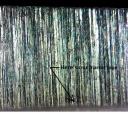


The roll turned out to be on the side opposite the photo above. That's fine because we mark both sides of the edge simultaneously by wrapping the pin striping tape over the edge and then use a razor blade to slice both sides and remove 
the small piece of tape that was covering the edge. This way both sides are marked exactly at the same point on the edge.  Once again we can see the rolled edge at 140X.  


Our experience tells us that 325 points of roll is pushing the envelope with consideration to restoring the edge. This proved to be the case. Our first attempt, using leather alone didn't get the job done. The first attempt with leather and a second attempt brought us back to only 225. We then tried one of the our HDPE plates and then the leather again and it did the trick.


Three final readings 146 - 151 - 151, so success. Here is a picture of the repaired (straightened) edge. 


Going to have to think about what the next step should be.

#60
Well we thought about it and decided that our next step should be to test the repeatability of the measurement post roll. The reproducible nature of the roll and repeatability  of the measurement will determine just how many things we can test for. If the post roll measurement is +/- 20-30 we can likely test for a lot of different factors. If the post roll measurement is +/- 50 we will likely be able to test for fewer factors. 

We conducted our tests using our new radius surface impactor at several different locations on the same edge. The results were something on the order of +/- 60. Not good on a scale of 300-350 (the extent of roll we intend to induce) . What is good is our edge tester's ability to point to and describe the extent of these very small edge inconsistencies. We want to do better than +/- 60.  This kind of resolution/repeatability would only be useful in determining the grossest differences in edge structure.  Of course, averaging of the readings would improve the error range from test to test. Statistically speaking, a group of four readings would reduce the error by 1/2.  We would like to minimize the use of and reliance on averaging in these tests. From our electronic days we learn that the way to reduce the need for measurement averaging is to improve the signal to noise ratio. In this case, an uneven roll represents "noise". If we homogenize the roll, our "noise" will be reduced and the ratio improved. It is obvious from these tests that the roll produced by the current impactor design is not homogenous across the impact area. In retrospect, one look at the photos we took previously confirm that. Here is one example:


The roll in the above picture appears not to be even. Depending on where the test media impinges on the edge, a wide range of readings may result. In view of the fact that the entire rolled section of the edge comprises a length along the edge of some .020" (20 thousandths) of an inch, predictable test media placement is impractical. We must, simply, improve on how we roll the edge. The better we get, the more information that can be derived from the instrument. 

We have ideas and are already at work on them.


Forum Jump:


Users browsing this thread: 6 Guest(s)