Posts: 287
Threads: 34
Joined: Oct 2017
(01-17-2018, 10:53 AM)EOU Wrote: ... The reason/cause for 229 versus 160 was not visually discernible using an optical microscope.
... Past experience tells us that 300 points of roll on stainless steel knives is just about the limit. Beyond that, edges usually cannot be fully restored.
I guess the edge in the impact area may look similar to this Todd's SEM image of a knife edge blunted by cutting cardboard
![[Image: blunted_edge.jpg]](http://knifegrinders.com.au/photos/blunted_edge.jpg)
http://knifeGrinders.com.au
Posts: 500
Threads: 38
Joined: Mar 2017
We're going to give a softer material a shot here Mark. We imagine that we're going to give lots of things a shot here before this is finished. Could be something as simple as a thin HDPE disc placed between piston rod and edge. We're just very encouraged that we were able to get so close so quickly. That's always nice and also, a little lucky.
Thanks for the SEM picture and your continued interest KG. We agree with your speculation concerning the higher scoring portion of the edge. Probably just squashed the apex a bit at one location. Might have been just one or two teeth in a toothy edge.
Once we iron out the kinks and establish a baseline on stainless knives we're going to have see how it performs on higher Rockwell C edges. Those are edges that are in short supply here but we know where they aren't, in your (KG and Mark R's) shops. We hope that you'll consider assisting us by testing a few edges in your shop when the time comes. We know that you own edge testers and we'd be happy to provide a test stand.
Posts: 361
Threads: 11
Joined: Mar 2017
My friend, Slovak sharpener Pavol Sandor, uses copper tube for edge testing. In his video you can see it in the time window 46:55 to 48:30.
https://www.youtube.com/watch?v=bfp80sYH6iw
He makes static test with inclined blade and forces 1000, 3000 and 5000 gf. He makes also a dynamic test when the blade with additional weight 1000 gf is dropped from a height of 100 mm (4").
Jan
Posts: 500
Threads: 38
Joined: Mar 2017
Thank you very much Jan for this information. As you may be aware Pavol is a customer of ours as well. We'll watch the video and get in touch with Pavol.
Posts: 287
Threads: 34
Joined: Oct 2017
01-18-2018, 01:43 PM
(This post was last modified: 01-19-2018, 02:37 AM by KnifeGrinders.)
Mike, I'd love to have this edge impact stand at my workshop.
Sure, will put all the super steels I have through it, compare with the known data on that steel hardness and edge retention, and share here.
But I see more areas of use than that for this little gizmo at our workshop and beyond.
The foil/wire/feather edge undetectable optically - a quick test on your stand should show whether an extra edge refinement is needed or not.
Knife makers may use it to detect a partially annealed edge.
Manufactures produce batches of knives with hardness specification of +/- 2, e.g. I've seen kitchen and meat processing professional knives specs of 55 +/-2, and I hope this test stand will help to differentiate the 53 HRC blade from 55 and 57.
Relation between your test result and HRC should be firm.
Ability to differentiate a quality batch can help the volume knife users save money.
Even my small rental knife business will benefit from having 57 HRC knives in the rent pool rather than 53 for the same money.
Another example - the day before yesterday I sharpened a customer's folder in CPM-20CV, and was not impressed with the edge retention. The tech specs state HRC of 59-61. To start with, there's a hell of difference in performance between the 59 and 61, and secondly all my hands-on experience was telling me the edge is at 57-58. I suspect that was a batch of not-optimal heat treatment. Your device can help tell that.
http://knifeGrinders.com.au
Posts: 500
Threads: 38
Joined: Mar 2017
You are right on the mark as we see it KG. The possibilities are very extensive. We'd all like to believe that our HRC60 edges are more durable than our HRC55 but are they and if so, how much more so? Additionally, how is edge structure/durability affected by bevel angle or initial sharpness level or grind geometry or sharpening techniques and methods? These are all questions that have been debated and contested for decades and some of them right here on the BESS Exchange. How definitively this device answers any or all of these questions remains to be seen but, with a little help from our friends, we're going to find out.
Thanks for your offer of help and cooperation in this project KG!
Posts: 500
Threads: 38
Joined: Mar 2017
Well you had to know that you were on the list Mark without even asking. If we can liken knife knowledge to tree removal then we're a machete and you and KG are chainsaws. Thanks for your offer to help and you can be certain that it will be accepted once we get the test stand up and running properly.
Posts: 500
Threads: 38
Joined: Mar 2017
Well we warned you that we wouldn't suffer through this development effort alone so here's the report. Plan "A" using the end of the 5/16" rod for a contactor has it's issues. The end of the contactor must be square to the edge at inception and remain square throughout the test if repeatable tests are to be made. Using our low-cost test stand and vise approach, this turns out to be not so simple.
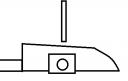
It is particularly difficult when attempting to test knives, like our chef's knife, where the edge is not parallel to the spine. This device has to be simple to use and inexpensive to reproduce so we're going to shift gears and change the contactor to a design where alignment/square is not as critical. Perhaps it will allow us to use weights less than the 10 pounds we currently use as well. A lower amount of weight would lower the stress to other elements of the test stand.
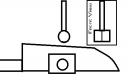
The contactor will now simply be a piece of 1.0" round bar. The radius of the bar will impinge on the edge. We'll mark the centerline with a very slight groove. We're going to build on a suggestion made by Me2 earlier in this thread and simply use cold rolled steel for a starting place. We don't doubt that 6061 aluminum would do the trick but we'll see. We'll first see if it works and then if it causes us issues in some other arena. We know now that we can move the edge a significant amount and then restore the edge so this is going to work. We just need to hammer out the kinks in our process.