| Welcome, Guest |
You have to register before you can post on our site.
|
| Forum Statistics |
» Members: 659
» Latest member: Anderson
» Forum threads: 490
» Forum posts: 5,464
Full Statistics
|
| Latest Threads |
BESS with woodworking too...
Forum: Woodworking Tools
Last Post: Anderson
08-21-2026, 02:26 AM
» Replies: 27
» Views: 85,500
|
Wire Edge Prevention
Forum: Burr Removal Methods, Testing and Results
Last Post: WI_Hedgehog
07-30-2026, 06:24 AM
» Replies: 64
» Views: 248,605
|
Protocol for BESS measure...
Forum: Edge Sharpness Testing
Last Post: WI_Hedgehog
07-24-2026, 10:00 AM
» Replies: 11
» Views: 10,216
|
How to prevent the edge o...
Forum: All About Edges
Last Post: WI_Hedgehog
04-30-2026, 01:12 PM
» Replies: 6
» Views: 18,030
|
Blade Taper Angle? - Supe...
Forum: All About Edges
Last Post: WI_Hedgehog
04-30-2026, 01:01 PM
» Replies: 9
» Views: 28,862
|
Knife dulls overnight aft...
Forum: All About Edges
Last Post: WI_Hedgehog
04-30-2026, 09:01 AM
» Replies: 27
» Views: 92,952
|
The DILAGON: a DIY laser ...
Forum: All About Edges
Last Post: WI_Hedgehog
04-30-2026, 07:57 AM
» Replies: 27
» Views: 117,596
|
Used Rapid Edge Extend-A-...
Forum: Relevant General Discussion
Last Post: WI_Hedgehog
04-30-2026, 06:49 AM
» Replies: 3
» Views: 8,484
|
Saved old tool (Fun with ...
Forum: Relevant General Discussion
Last Post: WI_Hedgehog
04-30-2026, 06:43 AM
» Replies: 1
» Views: 3,558
|
Mike Brubacher has passed
Forum: Relevant General Discussion
Last Post: WI_Hedgehog
04-30-2026, 06:15 AM
» Replies: 2
» Views: 3,057
|
|
|
| PT50 Case? |
|
Posted by: CasePeanut - 12-28-2020, 01:21 AM - Forum: BESS
- Replies (1)
|
 |
I keep my PT50B in a drawer in my garage/knife shop. I’ve kept it pretty clean so far, but was thinking about some kind of padded case to really keep the micarta and steel dust out. How do you store your PT50?
|

|
|
| Precision Sharpness Testing Device |
|
Posted by: Willy - 11-01-2020, 09:03 AM - Forum: Edge Sharpness Testing
- Replies (12)
|
|
Hi all,
I read a lot here in the forum and noticed that there can be some problems with the measurements if the user makes mistakes unconsciously. That is why I built a device that should deliver absolutely reproducible results (sorry, german language only, but I'm sure you will understand the function):
I used the BESS line and various fishing lines with the device. The lines are:
CE = Carbon Carp Expert 0.25 mm, measured 0.29 mm
TC = Tectan FCC (Fluorocarbon coated) 0.25 mm
TF = Tectan Fluorocarbon 0.25 mm
PF = Perca Forellen-Schnur Spezial Coating 0.25 mm
CF = Cormoran Profiline Forelle 0.25 mm
Unless otherwise stated, the thread tension is 100 cN for BESS and 300 cN for the other lines (1 cN ~ 1 g).
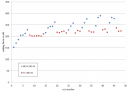
The first series of measurements was disillusioning. I expected better reproducibility:
Now other fishing lines were compared with the BESS thread:
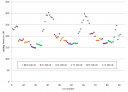
The BESS values show the greatest spread. Scattering? No, always an increase. I noticed this during the measurements (i.e. without a diagram) and before the last 3 measured values, the blade was wiped with dry kitchen paper. The following value was significantly lower. The last two values show the typical increase again. Hypothesis: the BESS thread leaves tiny deposits on the cutting edge that cannot be seen with a magnifying glass. Another thesis: these deposits were removed by the CE thread (decrease in the required cutting force).
Now the cutting edge was cleaned with dry kitchen paper after each cut:
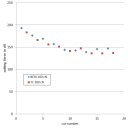
Up to the tenth cut, the cutting force decreased and the values are below those in the last figure. After that there is no further improvement, but the reproducibility is finally as good as I expected.
The knife position remains unchanged. In order to see whether all threads require a higher cutting force with increasing number of cuts, 10 cuts were carried out without intermediate cleaning. This was followed by thorough cleaning of the cutting edge with dry kitchen paper. The findings:
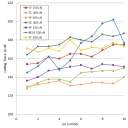
The Tectan Fluorocarbon line works best, which according to the packaging consists of 100% PVDF (polyvinylidene fluoride). The BESS thread shows the greatest increase and the greatest spread. Originally I had the secret assumption that the BESS thread was just a fishing line. Now a special coating seems likely to me. In addition, the fishing lines only require about 30 cN cutting force with a razor blade, while the BESS line requires the expected 50 cN.
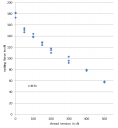
Now the cutting edge has been cleaned after each cut. The following diagram shows that a defined thread pre-tension must be applied for reproducible values:
|
|
|
|
| The burr can realign itself??? |
|
Posted by: SHARPCO - 10-31-2020, 11:34 PM - Forum: Burr Removal Methods, Testing and Results
- Replies (1)
|
 |
https://www.dovo.com/en/ratgeber/take-care-of-straight-razors-strops-shaving-brushes/
"To remove leather residue and cut hair from your straight razor, rinse it with warm water. Now carefully dab the straight razor dry with a soft cloth. Please be careful not to touch the cutting edge. Otherwise, you could damage the microscopic burr at the cutting edge. We recommend that you store the straight razor in a well-ventilated place, as this is the best way to protect the metal from tarnishing or oxidation. Since the burr of the straight razor bends slightly during shaving, leave the straight razor to rest for 48 hours. During this time, the burr can realign itself. Rub the blade with an acid-free oil such as a camellia or paraffin oil if you’re not going to shave in near future."
https://www.barberscorner.de/en/blog/care-stropping-of-straight-razors
"The fiber of the linen is soft, the mesh of the textile, however, is rough. This allows the linen to grip the burr and align it. The weave of the textile catches dirt and loose steel particles which could damage the sensitive edge when pressed against the strop. The final use of the strop makes the resulting edge finer. You should strop the razor before, and not after shaving. Steel has a certain level of self-healing power, or “memory.” After stress, the burr slowly and partially stands itself up again. If you violently rip the burr up with the strop immediately after shaving, this stresses the material, which shortens the life expectancy of the burr and, in the long run, of the razor. The razor should rest for at least 24 hours after the shave – but 48 hours or more is ideal, so if you shave every day, you should own at least two straight razors. Our grandfathers therefore often had sets for the entire week, containing 7 razors."
How do you think about that?
|
|
|
|
| Validity of manila rope edge retention testing |
|
Posted by: subwoofer - 10-19-2020, 09:46 AM - Forum: Edge Sharpness Testing
- Replies (8)
|
 |
I am about to embark upon some edge retention testing that I have not previously quantified with the BESS tester - manila rope cutting.
For my testing I plan to use 1" rope with a minimal wrap of insulating tape (just enough to overlap and completely cover). The use of the tape is three-fold; firstly to stop the rope unravelling, secondly to keep the fibres tightly together to try to make the material more consistent for each cut, and lastly to hopefully allow me to reduce waste by cutting off smaller sections as it is all held together.
I'd mark off a section of blade to 'saw' with, maybe 3" long, and cut onto a pine board.
Clearly I'm not proposing anything new with rope cutting itself, but maybe the full test process I'm going to use has not been tried.
What I have seen others do is to keep cutting (counting the cuts) until the edge won't get through the rope (or the effort is too high), or to cut a sheet of paper, cut the rope, and then cut the paper again, stopping when the paper is torn rather than sliced.
With the right slicing action I have been able to slice paper with an edge up to 400 BESS, so the paper test is not all that revealing to me.
My take on this is to instead introduce the BESS test perhaps after every cut of the rope (to be decided). Even if I never reach the point it won't cut the rope, I would have a log of cuts vs BESS.
There are many problems with this test including blade geometry, length of edge used in the cut, apparent effort (affected by the handle shape/size), batches of rope production etc, so I know it is flawed. To date, my work with the very controlled SET has found various anomalies and poor SET performances for blades that seem to do very well in real world use.
Has anyone already done this or have results proving or disproving the validity of rope cutting testing?
|
|
|
|
|





![[Image: wmf.jpg]](https://smarino2593.files.wordpress.com/2011/09/wmf.jpg)
